Diamonds built Botswana. For decades, they funded everything — roads, schools, hospitals, the entire public sector. Now production is collapsing, revenues are crashing, and the country that had more time than almost any other African nation to prepare is scrambling. This is the story of how we got here.
Orapa, 2026. Debswana just cut shifts again. Workers stare at padlocked gates and empty yards. Families that depended on diamond wages scramble for piece jobs. The town that diamonds built is now feeling what diamonds are doing — and Selebi Phikwe's story, which we told last week, is starting to rhyme.
Botswana's economy is a one-trick pony. For over fifty years, diamonds delivered growth, infrastructure and stability. Today that same resource is dragging the country into recession — and exposing decades of planning that looked good on paper and achieved very little on the ground.
The numbers are not in dispute
Diamonds account for between 70 and 80 percent of Botswana's total export earnings, roughly 25 to 30 percent of GDP, and close to one-third of all government revenue. That single commodity paid for the modern state — the roads, the clinics, the university, the bloated public sector that employed three generations of Batswana.
Then the crash came.
Debswana slashed production by 27 percent in 2024, to just 17.9 million carats. In 2025, output fell again — to around 15 million carats. That is a 40 percent decline from 2023 levels in two years. Sales revenues collapsed by up to 46 percent. Overall mineral revenue came in 59 percent below historical averages in the 2025/26 fiscal year. The national stockpile ballooned to 12 million carats — nearly double the government's own target.
The result was a double recession. GDP contracted by 3 percent in 2024 and a further 0.4 to 1 percent in 2025. Foreign exchange reserves now cover only around five months of imports. The Pula Fund — Botswana's sovereign wealth buffer built on decades of diamond surpluses — has been heavily drawn down.
This is not a temporary dip
Global demand for natural diamonds is structurally weak. Lab-grown stones are flooding the market at prices that continue to fall. The luxury segment, which sustained Botswana's premium rough, is under pressure. Stockpiles are growing because buyers are not clearing them fast enough at prices the government considers acceptable.
Debswana's mining licences run to 2054. But recoverable reserves are finite, ore grades are declining as mines go deeper, and the revenue model that underpinned thirty years of Botswana's development is being permanently restructured around it.
"Botswana's challenge is not just the diamond market cycle. It is that the country built its entire fiscal architecture on a single commodity whose long-term trajectory is now genuinely uncertain." — Financial analyst quoted in Business Weekly & Review, January 2026
The complacency that built the trap
This was predictable. More than that — it was predicted.
Vision 2016 talked about diversification. Vision 2036 repeated the same ambitions. Multiple National Development Plans named the private sector, tourism, financial services and agriculture as the pillars of a post-diamond economy. Billions of Pula in diamond revenues passed through the treasury during the BDP's decades in power. International advisors, development partners and economists raised the alarm repeatedly.
None of it translated into a resilient economy.
The non-mining private sector remained small, dependent and sheltered. Education and skills development did not produce the workforce a diversified economy requires. High public wages, easy diamond rents and a culture of government-as-employer crowded out the entrepreneurship and investment that could have taken root. This is Dutch disease in its most straightforward form — a resource windfall that makes everything else uncompetitive by comparison.
Successive BDP governments treated diamond money as an endless ATM. When the receipts were good, the pressure to diversify was low. When the pressure should have been high — during downturns — the instinct was to wait for the cycle to turn rather than use the crisis to force structural change.
The EU flagged exactly this pattern in Selebi Phikwe in 1991, channelling over 60 million euros into economic diversification for a mining town that was already showing signs of fragility. That money sat largely unspent when BCL collapsed in 2016. The diamond story is the same lesson at national scale.
What the current government inherited — and what it has done with it
The UDC came to power in late 2024 on a mandate for accountability and change. It inherited collapsing revenues, a shrinking sovereign fund, rising debt, and an economy structurally unequipped for the moment it is now facing.
To be fair — they inherited a crisis that was not of their making. The old regime built this trap across decades.
But the question now is what is being built in its place. Budget speeches have acknowledged the challenge. Ministers have spoken about economic diversification and private sector development. There have been conversations about the Special Economic Zones, about tourism investment, about the financial services sector.
What there has not been — at least not yet — is the kind of bold, measurable, time-bound industrial policy that the scale of this problem demands. Not another vision document. Not another plan. Actual new industries. Real private investment at scale. A credible answer to a young population watching its economic future narrow.
"We cannot continue to depend on diamonds. The time to act is now." — Minister of Finance, 2025 Budget Speech
The words are right. The urgency of the implementation will be the real test.
The human cost is already here
Mining towns are not waiting for policy papers. Orapa, Jwaneng and Letlhakane are already feeling the layoffs, the service cuts, the families leaving. Young people who were already battling unemployment in good years are now entering a labour market with fewer options and a government with fewer resources to cushion the blow.
Nationally, the consequences compound. Less revenue for health, education and infrastructure at exactly the moment when they matter most. The tax base narrows as the economy contracts. Inequality widens between those in the formal economy and those outside it. Botswana's ambition to reach high-income status by 2036 — already ambitious before this crisis — has moved further away.
The Pula Fund, built over decades to protect against precisely this kind of shock, is being spent. When it is gone, the buffer is gone.
The question that needs an honest answer
How did a country blessed with decades of diamond billions, more warning time than almost any other resource economy on the continent, and the genuine goodwill of international partners — fail to build an economy that could survive without them?
The answer is not complicated. It is uncomfortable.
Political incentives favoured stability over transformation. Diamond money reduced the urgency of hard choices. The civil service grew. The private sector did not. And a culture of deference — to the ruling party, to the diamond companies, to the path of least resistance — made accountability rare and genuine reform rarer.
The old regime built this trap. It had fifty years and the resources of a small fortune to do otherwise.
What comes next
The mines will not close tomorrow. Jwaneng remains one of the richest diamond deposits on earth by value. Debswana will keep producing. Revenues will not fall to zero.
But the structural shift is real and it is permanent. The era in which diamonds could fund the entire Botswana state — its wages, its infrastructure, its social contract — is ending. Whether it ends in ten years or twenty, the direction is not in doubt.
What Botswana needs now is not more extensions of mining deals as a substitute for strategy. It is not slogans about Botswana First while the same dependencies deepen. It is a government willing to make the decisions its predecessors deferred — on skills, on industrial policy, on land and regulation reform, on building a private sector that can actually employ people.
The window is not closed. But it is closing.
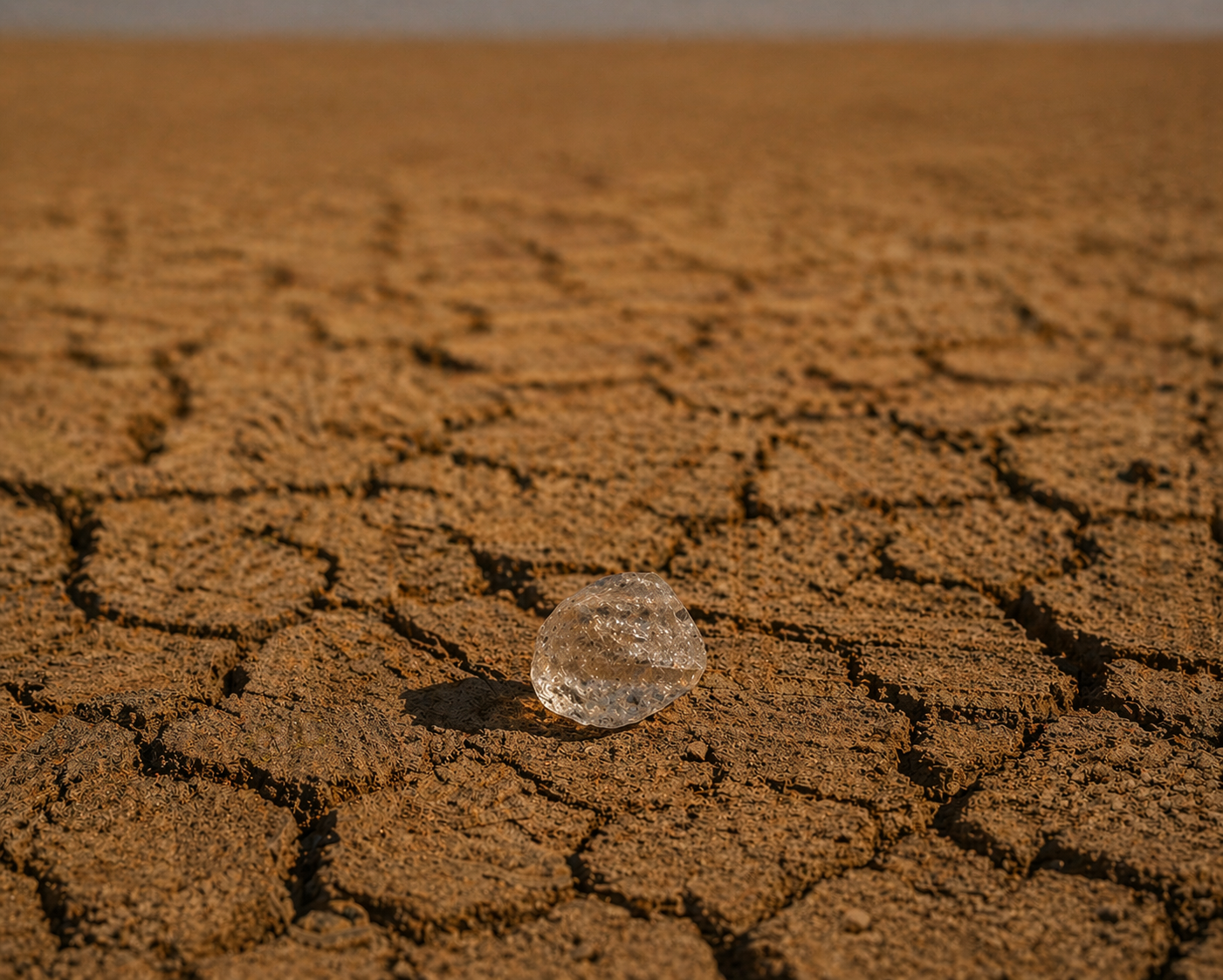
The stockpile is growing. The people are watching. The stones will not wait.
Sources: Botswana Daily News, Business Weekly & Review, Mmegi Online, The Botswana Gazette, Sunday Standard Botswana, Debswana Annual Reports, Ministry of Finance Budget Speeches 2024–2026, Bank of Botswana Annual Reports.