From a quiet success with Namibia to a parliamentary revolt over Zimbabwe — what thirty years of failed regional integration tell us about why Botswana's most important border decision is still unresolved.
In February 2023, two neighbouring countries did something that thirty years of regional diplomacy had failed to make routine: they opened their shared border to each other's citizens on the strength of a national identity card alone. No passport required. Botswana and Namibia made it look easy. That impression, it turns out, was misleading — and it set up the harder conversation that is now unresolved in Harare.
The question of whether Botswana should remove passport requirements for Zimbabwean travellers is not a simple one, and anyone who tells you it is has not looked at the numbers, the history, or the infrastructure. It is a question about sequencing, capacity, trust and political honesty — about who benefits from open borders, who bears the cost of getting them wrong, and whether the governments involved are genuinely willing to do what is unglamorous but necessary before they do what is visionary but premature.
SADC and the Thirty-Year Promise That Was Never Kept
The Southern African Development Community attempted this once before. In 1995, SADC circulated a draft Protocol on the Free Movement of Persons — ambitious, pan-Africanist in spirit, modelled on the kind of continental mobility that the founding generation of independence leaders had imagined. It collapsed almost immediately. South Africa, Botswana and Namibia withdrew. The reason given was blunt and has never really changed: income disparities between member states create migration imbalances that no framework then available could responsibly absorb.
A second attempt came in 2005 — a more cautious Protocol on the Facilitation of Movement of Persons, granting visa-free entry of up to ninety days. More than twenty years later, it remains inoperative. Only six of SADC's sixteen member states have ratified it, well short of the threshold required for legal force. The regional architecture that was supposed to make bilateral deals like the Botswana-Zimbabwe one unnecessary has simply never been built.
|
The SADC context Around
80% of SADC citizens can now travel visa-free or with a visa on arrival
within the region for short stays. But for longer-term movement — work,
residence, settlement — documentary requirements remain strict,
administrative costs are high, and gaps in enforcement drive irregular
migration across every major corridor. |
This matters because it means that when Presidents Boko and Mnangagwa sit down to talk about open borders, they are not implementing a regional framework. They are improvising one — trying to build bilaterally what the region has spent three decades failing to construct collectively. That is a heavier lift than the diplomatic language tends to suggest.
"SADC member states have been confronted with serious feasibility challenges, complexities, risks and dilemmas as they attempt to implement commitments towards the free movement of people — with political, security, economic, strategic and technical factors often cited as obstacles."— Strategic Review for Southern Africa, 2023
The regional architecture that was supposed to make bilateral deals unnecessary has simply never been built. Botswana is not implementing a framework. It is improvising one.
The One That Worked: What Namibia Got Right
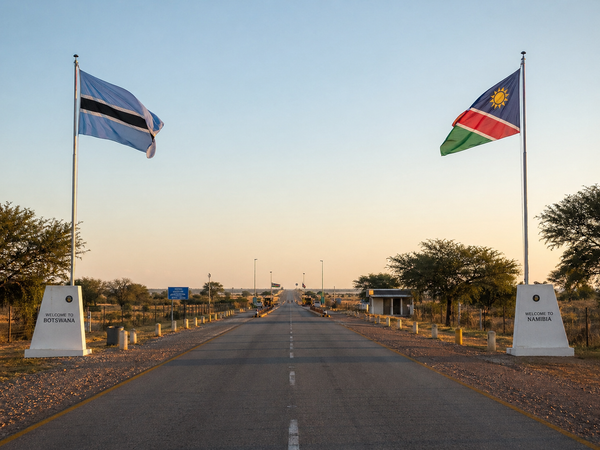
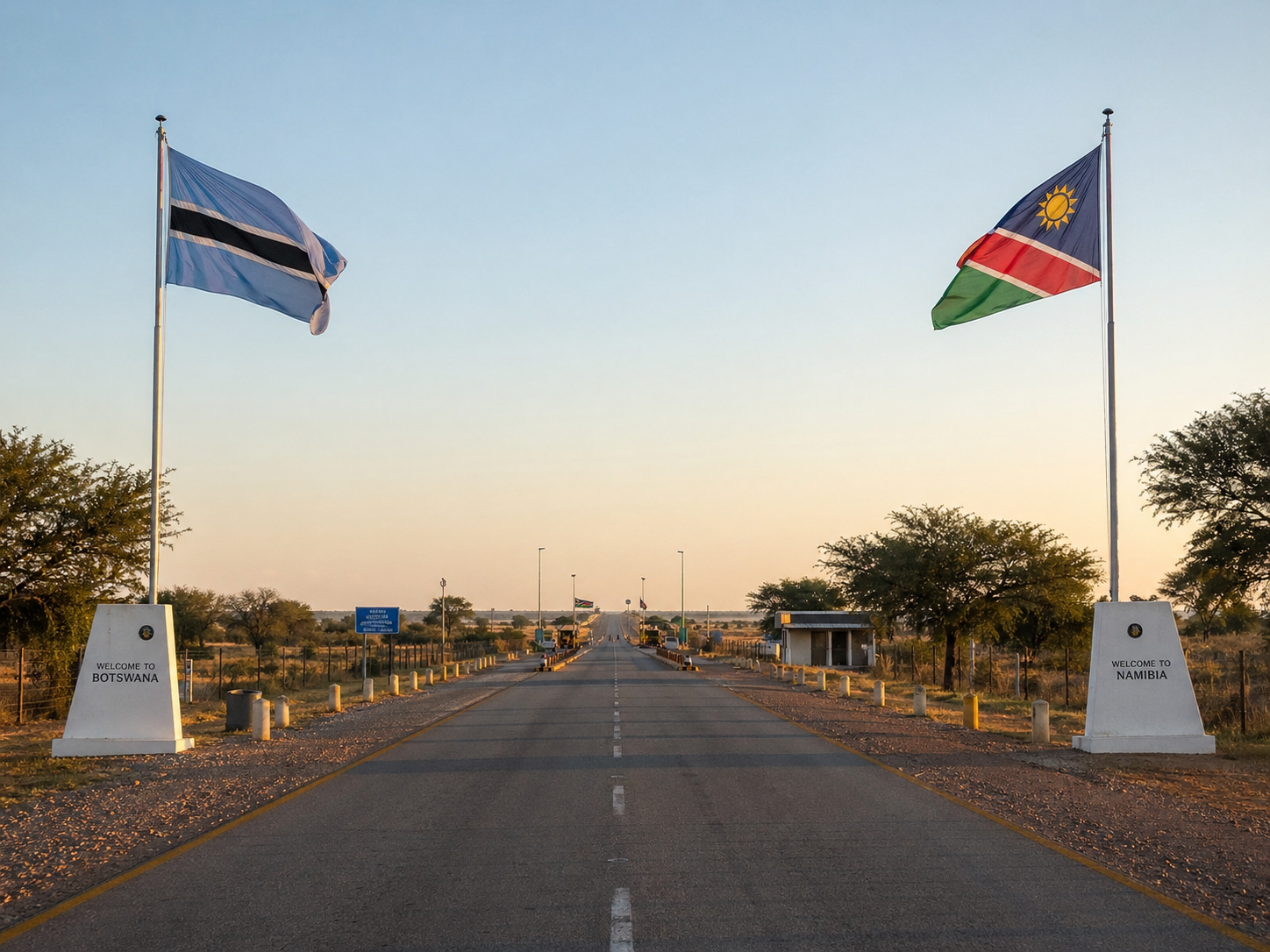
In February 2023, Botswana and Namibia became the first countries in Southern Africa to implement a working passport-free travel arrangement. Citizens of both nations could cross their shared border using only national identity documents. There was no parliamentary backlash, no public anxiety, no confusion at the crossings. It was implemented smoothly and is still regarded as a success.
Understanding why it worked is more important than the fact that it did. The two economies are broadly comparable. Botswana's GDP per capita and Namibia's are in a similar range by regional standards. The flow of people across the border has historically been balanced in both directions — neither country was receiving a one-way flood of economic migrants from the other. The perceived risks on both sides were low, and the political incentive to cooperate was genuine and roughly equal.
Namibia also shares with Botswana a broadly similar institutional environment — comparable ID systems, comparable border management capacity, and comparable public trust in government documentation. When the agreement was reached, both sides could be reasonably confident that a national ID card presented at the border actually meant what it said.
|
01 Comparable economies Botswana
and Namibia sit in a similar GDP-per-capita range by regional standards.
Neither was asking the other to absorb economically driven mass migration. |
02 Balanced migration flows People
moved in both directions. There was no one-way pressure corridor. The
perceived risk was genuinely symmetric. |
|
03 Matched institutional capacity Comparable
ID systems, comparable border management, comparable public trust in
government documentation. A national ID presented at the crossing actually
meant what it said. |
04 Mutual political interest The
incentive to cooperate was genuine and roughly equal. Neither side was
absorbing the deal reluctantly to accommodate the other. |
Namibia became the model — and in some ways raised expectations that the next deal would be just as straightforward. Those expectations were wrong.
The Announcement That Broke the Process: Zimbabwe, 2023
Later in 2023, then-President Mokgweetsi Masisi and Zimbabwe's Emmerson Mnangagwa jointly announced that the two countries had agreed to abolish passport requirements at their shared border. The announcement was made confidently, presented as settled policy. In Gaborone's National Assembly, it landed like a thunderclap.
Members of Parliament from across the political spectrum pushed back hard, on both the substance and the process. The opposition leader did not mince his words.
"We don't know who President Masisi was representing when he reached this agreement with Mnangagwa or the government of Zimbabwe."— Dithapelo Keorapetse, Opposition Leader, National Assembly, 2023
The backlash was significant enough that the Minister of Labour and Home Affairs was compelled to appear before Parliament and clarify that no binding agreement had actually been signed. The fact that two leaders had agreed on a concept did not mean citizens could begin crossing with ID cards. Processes, legal frameworks and consultations had to come first. Talks were suspended. Botswana informed Zimbabwe it was still consulting its citizens.
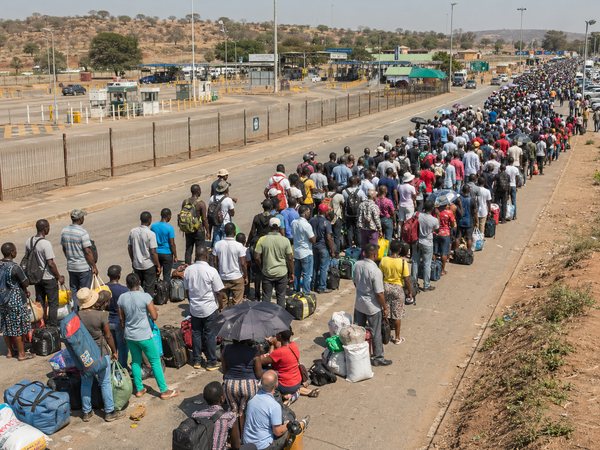
The confusion was not just political. At border crossings, some citizens attempted to enter using only their national IDs before any policy change had been implemented. The 2023 episode demonstrated, in the most direct way possible, what happens when a border policy is announced before it exists: the announcement becomes the policy, in the minds of those who act on it — and the consequences fall on border officials, local communities and the migrants themselves.
|
The 2023 lesson A
diplomatic announcement is not a border policy. The gap between a statement
made at a presidential summit and a functioning system at a border post is
wide, technical and consequential. Closing it requires legislation,
infrastructure and genuine public buy-in — none of which can be produced by a
press conference. |
· · ·
|
Coming in Part Two The
Stakes: The Numbers Behind the Nervousness |