It is Day 3. That is what @BPCBw posted on X on the evening of Tuesday, 21 April 2026. A load shedding schedule. North, South, and Central regions. Between 6PM and 8PM. "Subject to change." The national electricity utility was publishing a darkness timetable while simultaneously running a hashtag #PoweringBotswanaToProsperity — across its social media. The Bank of Botswana Governor had already told the nation in February that this utility's proposed 46% tariff hike was an inflation risk. Industry had rejected that hike at a public hearing. BERA said no decision had been made. And Batswana — in homes, restaurants, clinics, and school rooms across the country — were sitting in the dark asking a question that has gone unanswered for nearly two decades: how is this still happening?
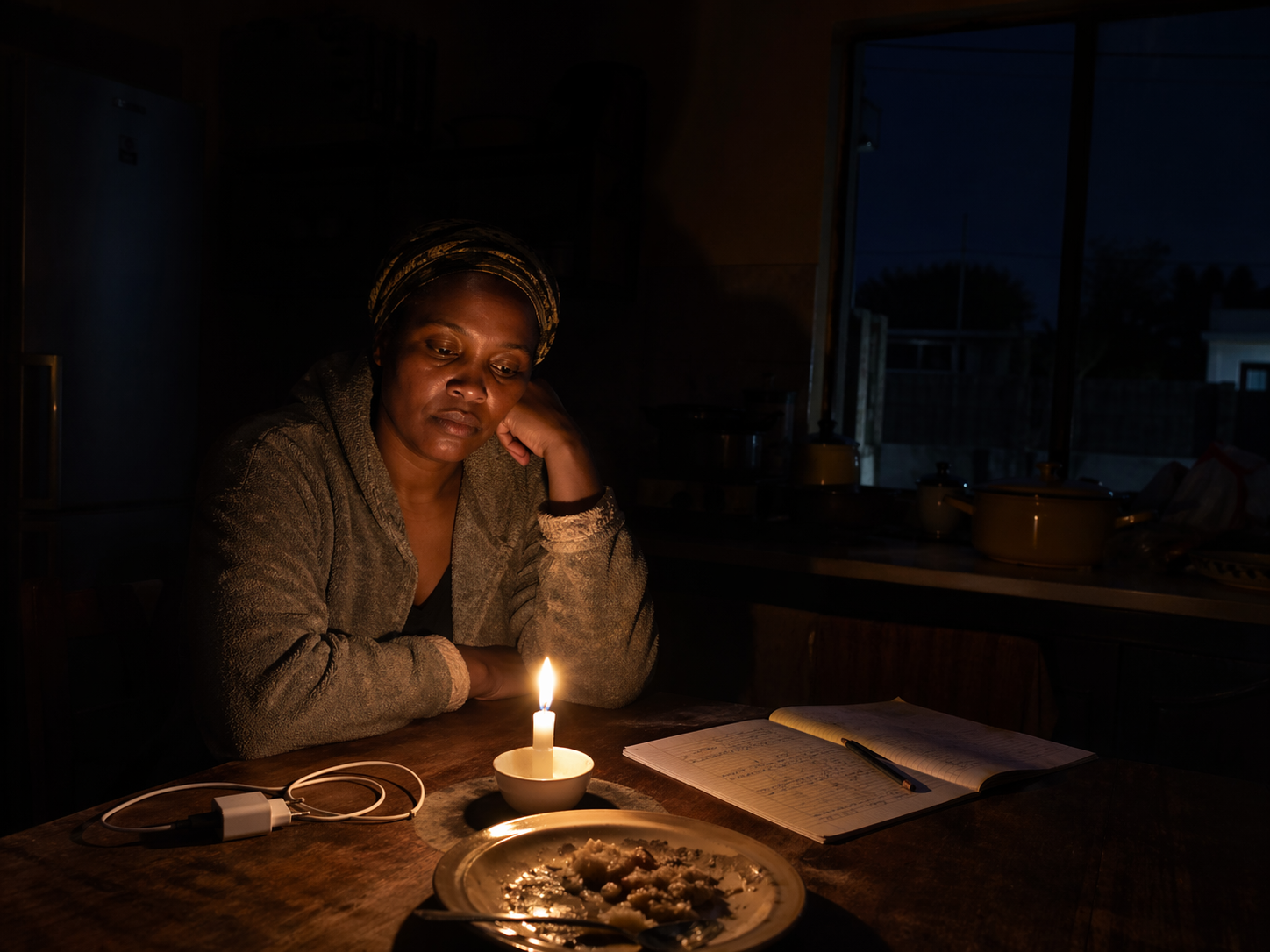
Gaborone, Block 8. 7:04 PM.
The lights go out mid-sentence. A student's laptop dies — there was no warning to charge it. A restaurant on the corner kills its fridge, its fryer, its music. The owner reaches under the counter for a candle without looking up. She keeps them in bulk now. A small manufacturer in the industrial area — already operating on margins BEMA described last month as "razor-thin" — shuts down his press early. Another two hours of lost output. Another evening absorbed without compensation.
This is not a metaphor. This is a Tuesday evening in Botswana's capital in 2026. And if you think this is new, you have not been paying attention.
The hashtag says everything
BPC's social media runs two stories at once. The official story — #PoweringBotswanaToProsperity, #PowerYourLove — is about warmth and national partnership. The other story runs underneath it in the form of daily "Power Hour Supply Reports," each carrying the same quiet admission buried at the bottom like a legal disclaimer nobody reads until the lights go out.
"Reliability challenges persist on units that have not yet undergone remediation. As a result, forced outages and short-duration 'pit-stop' maintenance interventions will continue."
On 21 April 2026, that became a Day 3 load shedding notice for the entire country. Gabz FM's senior reporter Tebogo Mokoto described the public response as one of "disbelief." "The main thing is really shock," she said. "Everyone is wondering how maintenance has not resolved the issues BPC has pointed to."
Shock. After nineteen years of the same problem. That, in itself, is its own kind of verdict.
The generation numbers are worse than they sound
Botswana's ambition was to be a net electricity exporter. That is what government documents have promised, across multiple administrations, for years. Here is where we actually stand.
Statistics Botswana's Electricity Generation Report for Q3 2025 states the following without flinching: the Index of Electricity Generation fell to 144.3 — down 38.6 percent year-on-year from 235.1 in Q3 2024. Domestic generation dropped by 28,684 MWh due to operational setbacks at Morupule A and B. And to fill the gap, Botswana's electricity imports jumped 120.7 percent year-on-year to 521,003 MWh.
Domestic generation collapsed by nearly 40 percent. Imports more than doubled. In a single year.
Botswana's peak demand is approximately 640 MW. The country's total installed capacity is around 1,400–1,500 MW — but theoretical capacity and actual generation are entirely different numbers when the main plant is in a state of permanent convalescence. Morupule B alone is supposed to supply 600 MW. At its worst, it was operating at 33 percent of that. In practice, Botswana is currently generating approximately 8 percent of its electricity from renewable sources, while importing between 60 and 70 percent of its power from South Africa through the Southern African Power Pool.
The country's own Integrated Resource Plan targets 50 percent renewable energy by 2030. That is in four years. From a base of 8 percent. With Morupule B still the backbone of the grid.
The gap between where Botswana is and where it promised to be is not a planning error. It is a decade of deferred decisions.
The Bill That Nobody Wants to Talk About
Here is the number that BPC and government spokespeople have perfected the art of mentioning without dwelling on.
Botswana owes Eskom P2.6 to P2.7 billion — the figure cited by both Mining Weekly and President Boko himself at a kgotla in Letlhakeng. That is the debt owed to the same South African utility Botswana is wholly dependent on to keep its grid stable. Eskom has been pushing for settlement ahead of import renegotiation talks. That gives the supplier leverage over the buyer that no sovereign nation should be comfortable with.
And the BPC creditor balance does not stop at Eskom. As of January 2025, BPC's total creditor balance stood at P2.6 billion across all creditors — including Morupule Coal Mine, whose unpaid bills carry the risk of coal supply failure. If the mine cuts off coal because it is owed money, the power stations stop producing, which means no revenue to pay the mine. BPC's own internal documents have acknowledged this circular trap in writing.
Meanwhile, the country's annual electricity import costs exceed $300–400 million USD. Every year, that money leaves Botswana. Every year, it does not build a transmission line, a solar panel, or a reservoir. And on the fiscal side, the picture is even bleaker: Botswana's 2025/26 budget deficit was revised upward to P25.5 billion — 9.3 percent of GDP — against a backdrop of collapsing mineral revenues. Total government debt, including guarantees, now stands at P90 billion, or 33 percent of GDP.
This is not a utility in crisis. This is a utility in crisis inside a government in crisis inside an economy in crisis.
The P16 Billion Monument to Bad Decisions
To understand how we got here, you have to start at the beginning. And the beginning is shameful.
In 2008, BPC signed an Engineering, Procurement and Construction contract with China National Electric Engineering Company (CNEEC) to design, build and commission the Morupule B Power Station. The funding: a USD 825 million loan from the Industrial and Commercial Bank of China. By the time all costs were tallied, the total had climbed to over P16 billion.
For a plant that — in 2026 — still cannot reliably keep the lights on in a country of 2.6 million people.
The World Bank, in a 2016 assessment, identified the root cause. The Prequalification document had asked bidders for pulverised coal boiler technology — what BPC knew and had operated at Morupule A. The Request for Proposals, the final step before awarding the tender, changed the specifications entirely. Bidders were now asked for a Circulating Fluidised Bed boiler design — a technology neither BPC nor CNEEC had meaningful operational experience with. "This discrepancy regarding the technology of the plant created a major risk in the selection of the contractor," the World Bank noted, "as the firms prequalified for one technology were invited to bid for another."
Someone changed the technical specifications after bidding had opened. An inexperienced contractor won a nearly billion-dollar contract. The World Bank identified it as structurally flawed in 2016. Remediation efforts were undertaken from 2014 onward — and the plant's Energy Availability Factor still averaged only 57 percent between 2014 and 2019, against an industry standard of 85 percent. From 2020 to 2022, it collapsed to 33 percent.
Here is the detail that should end careers: in May 2023, BPC's own CEO stood before journalists and stated that Morupule B would be fully operational by 2026. In March 2024, the Minister of Minerals and Energy revised that promise — remedial works would now be complete by mid-2027. It is now April 2026. The plant is still posting Day 3 load shedding schedules.
Every revised deadline is a broken promise. Every broken promise is a cost absorbed by Batswana who were not consulted and will not be compensated.
The 46% That Is Coming For Your Wallet
While load shedding notices were being posted, another crisis was developing in official channels — one that will not end when the lights come back on.
In December 2025, BPC submitted an application to the Botswana Energy Regulatory Authority (BERA) requesting an average 46 percent increase in electricity tariffs for 2026/27. The household adjustment was proposed at 68 percent. In a country whose economy contracted in both 2024 and 2025. In a country where youth unemployment is at levels that keep ministers awake at night.
BPC's stated reasons, as noted in BERA's public documentation, were explicit: recurring financial losses due to non-cost-reflective tariffs, unreliable local generation, heavy reliance on costly imports, escalating fuel and maintenance costs, and a prolonged period without tariff adjustment prior to 2025/26.
All of that is true. And all of it is the consequence of the P16 billion failure described above.
BERA held a public hearing on 10 February 2026. The response was unequivocal. Industry bodies and stakeholders firmly rejected the application. The Botswana Exporters and Manufacturers Association (BEMA) warned in writing that the increase would make locally manufactured goods uncompetitive in both regional and international markets, eroding profit margins it described as already "razor-thin." The mining sector — Botswana's largest employer — stated that with the proposed increase, electricity costs for power-intensive operations would have "nearly doubled within a short period."
Then came the most authoritative voice of all.
On 25 February 2026, Bank of Botswana Governor Lesego Moseki stood before the nation's monetary policy meeting and stated directly: inflation risks are high due to the proposed 46 percent electricity tariff increase. The central bank. The institution responsible for price stability. Naming BPC's tariff application as a threat to the economy.
This is not a small detail. This is the Bank of Botswana telling government, in formal monetary policy language, that approving this tariff hike will push inflation above comfortable levels in an economy that cannot afford it. Annual inflation was already 4.2 percent in March 2026 — the highest since June 2023 — before the tariff increase has even been approved.
On 1 April, BERA issued a statement saying reports of a 46 percent increase were "premature and unfounded." No decision had been made. The review process was ongoing.
Translation: BPC asked for 68 percent more from households. The central bank said it would destabilise inflation. Industry said it would destroy competitiveness. BERA said wait. And in the meantime, the lights keep going out and the debt keeps growing.
What This Does to the Economy
This is not just a utility story. It is an economic story — and the costs compound in every direction.
The Jwaneng diamond mine — one of the richest diamond deposits on earth by value — has experienced production disruptions during South African power crisis periods, demonstrating how energy dependency creates cascading vulnerabilities across Botswana's most critical revenue sector. Diamond mining constitutes approximately 30 percent of Botswana's GDP. When Morupule B fails, it does not just inconvenience households. It cuts into the production numbers of the industry that pays for everything else.
For manufacturers, the calculation is brutal. BEMA has already said profit margins are razor-thin. An unreliable electricity supply plus a 68 percent household tariff increase is not compatible with the diversification agenda government has been articulating for twenty years. You cannot build factories that depend on power that is not there. You cannot compete in regional markets when your input costs are artificially inflated by an infrastructure failure that was paid for and not delivered.
Business Botswana's own surveys have consistently flagged electricity reliability as one of the primary barriers to private investment and industrial development. The gap between the economic transformation Botswana promises and the energy reality it delivers is, at this point, structural.
The New Coal Question Nobody Is Asking Loudly Enough
Here is a revelation buried in parliamentary proceedings that deserves its own headline.
Energy Minister Bogolo Kenewendo told lawmakers that should Morupule B's remedial works not achieve their intended objectives, the government is considering a brownfield 615-megawatt coal-fired power plant — with an implementation timeline of 18 to 24 months.
Let that sit for a moment.
Botswana is simultaneously groundbreaking a 500MW solar plant with Oman, announcing an IRP targeting 50 percent renewable energy by 2030, and positioning itself as a regional energy hub powered by clean energy. And also quietly keeping a new coal plant on the table. In 2026. When Botswana has 3,200 hours of annual sunshine and the world's renewable energy transition is already underway.
A previous attempt to expand coal capacity by 600MW in 2019 collapsed when the government declined to provide guarantees to winning bidders. If a new coal plant is the backup plan for a failed coal plant, then the solar ambitions being celebrated in Maun are one Morupule B breakdown away from being shelved.
Batswana deserve to know: is the 500MW Maun solar project the plan? Or is it the announcement?
What BPC CEO David Kgoboko Said in Maun
At the Maun groundbreaking on 16 April 2026, BPC CEO David Kgoboko offered the clearest articulation yet of why the solar-battery combination changes the equation.
The 500MW project includes a 500 megawatt-hour battery energy storage system — the first of its kind at grid scale in the SADC region. Kgoboko explained that the battery would be charged during the day from solar generation and recharged again during off-peak hours overnight, creating a steady reserve deployable when demand peaks in the evenings. He noted that Botswana's existing solar installations in Maun and Jwaneng — both operating at 100MW — lack storage capacity entirely. Without storage, solar power evaporates at sunset precisely when households need it most.
"For years, Botswana has relied heavily on imported electricity during peak demand periods, particularly in the evenings and early mornings," Kgoboko said. "These imports often come at a high cost, exposing the country to price shocks and external supply risks. The Maun project is designed to directly address this challenge."
In the long term, he added, the project could position Botswana as a net exporter of electricity in the region.
These are the right words. The right technology. The right ambition. But Kgoboko is also the CEO of a corporation whose Morupule B unit was promised to be fully operational in 2026 — and is still posting load shedding schedules on Day 3.
Words are not megawatts.
The Unbundling Nobody Announced
There is one structural change that has been almost entirely absent from public discussion.
On 15 July 2025, the Botswana government began unbundling BPC — separating generation operations from transmission and distribution. This is a significant policy shift. A vertically integrated BPC has monopolised the sector since 1970. Unbundling, if properly implemented, opens the door to independent power producers, to private capital in generation, and to a more competitive market structure.
But unbundling is also meaningless if the generation side of the new structure is still Morupule B.
Government has issued a tender for 1.5 GW of renewable energy. The first pipeline of 335 MW in solar independent power producers is reportedly at various stages of development. These are real steps. The question Batswana and investors need answered is: what is the delivery timeline? What are the penalties for delay? And who holds accountability if the IRP's 2030 targets are missed the way the 2026 Morupule B targets were missed?
A Cold, Dark Winter Is Coming
Autumn has arrived. Winter — the period of peak electricity demand in Botswana — is weeks away.
BPC's own operational data acknowledges that reliability challenges persist on units not yet remediated, and that forced outages will continue based on plant condition. When asked about solar failing to supplement during recent load shedding, BPC confirmed that widespread cloud cover had cut solar output — meaning the newly installed farms could not provide backup. The coal plant was broken. The solar was clouded out. The import arrangement was constrained by debt.
Two hours. North. South. Central. Dark.
This will happen again. Possibly for longer. During the coldest months of the year.
The Questions That Have No Answer — Yet
Who approved the switch from pulverised coal to Circulating Fluidised Bed technology at Morupule B after bidding had already started? Who awarded USD 825 million to an inexperienced contractor? Who signed off on continued payments when the World Bank flagged structural failure in 2016? Who resisted the German CEO's solar plan? Who let the Eskom debt reach P2.7 billion without a settlement plan? Who authorised the May 2023 promise that Morupule B would be "fully operational in 2026" — and what happens to the official who made that promise now that 2026 has arrived?
Is anyone at BPC ever held to account? How is it business as usual when Batswana taxpayers continue to bankroll an institution whose flagship product — reliable electricity — has not been reliably delivered in nineteen years?
The UDC inherited this crisis. That is true and it matters. The Boko administration took power in October 2024 and found a P2.7 billion electricity debt, a plant that cannot hit its targets, and an IRP that had been announcing renewable energy milestones for years without delivering them at scale. That inheritance is real.
But accountability cannot stop at the previous administration. The unbundling of BPC, the Maun groundbreaking, the 1.5 GW renewable tender — these are decisions made now, by a government with the authority to demand answers from the people who built this failure. Answers should be forthcoming. Not eventually. Now.
What Botswana Deserves
Not hashtags. Not apologies. Not Day 3 schedules posted at 1PM for cuts starting at 6PM.
Batswana deserve a government that tells them the truth about timelines — not the aspirational version, the operational version. They deserve a BPC that faces consequences, not just press conferences. They deserve an energy regulatory authority that can tell a utility: no, 68 percent is not a reasonable household tariff increase in a recessionary economy, and you will restructure your operations before you pass your failures to consumers. They deserve to know whether the 500MW Maun solar project is Botswana's actual future — or a backdrop for a groundbreaking ceremony while the coal backup plan quietly stays on the table.
And they deserve to know: who decided that Morupule B was good enough? Who decided, in the face of 3,200 annual hours of Kalahari sunshine, that a failing coal plant built on the wrong technology was preferable to solar? Who made those calls? And where are those people now?
The lights will come back on tonight. They will go out again tomorrow. Day 4 is already scheduled. The only question left is whether this generation of leaders — elected on the promise of accountability — will finally name the people responsible for the nineteen years of darkness that got us here.
Sources: Botswana Power Corporation — @BPCBw (X / Twitter / Facebook), BERA Public Notice — BPC 2026-27 Tariff Application (December 2025), Mmegi Online, allAfrica / Botswana Daily News, Sunday Standard Botswana, The Botswana Gazette, Business Weekly & Review Botswana, YourBotswana, Gabz FM / Jacaranda FM Newswatch, Bloomberg (Bank of Botswana Monetary Policy Statement, February 2026), Mining Weekly, Moneyweb, Statistics Botswana — Electricity Generation Report Q3 2025, Global Energy Monitor — Morupule B Power Station, World Bank — Morupule B Assessment 2016 & Botswana Renewable Energy Support and Access Accelerator Project, Botswana Mining Review, Discovery Alert (Botswana-Oman Solar Deal Analysis, April 2026), BEMA public submission to BERA (February 2026).
Share