The numbers behind the nervousness, the human cost of getting this wrong, and the case — carefully made — for opening anyway.
The Namibia deal worked partly because the conditions were symmetric. The Zimbabwe situation is almost the opposite. To understand the public and parliamentary nervousness in Botswana, you have to look directly at the scale and nature of Zimbabwean emigration — and at what has already happened along the Botswana-Zimbabwe corridor without any border liberalisation at all.
The Numbers Behind the Nervousness: Zimbabwe's Migration Reality
Zimbabwe is the top country of origin of immigrants residing in Southern Africa, accounting for 14% of the region's total immigrant population — approximately 911,981 people recorded, with the real number widely acknowledged to be significantly higher due to the circular and irregular nature of emigration. Botswana is already among Zimbabwe's top five destination countries. The migration pressure along this corridor is not hypothetical. It is structural and ongoing.
|
911K+ Zimbabweans recorded living across Southern Africa — 14%
of the region's migrant population |
2,500 Irregular Zimbabweans deported by Botswana per month at
the peak of Zimbabwe's crisis, 2004 |
91,413 Zimbabwean migrants returned from Botswana and South
Africa in just two years, 2018–2020 |
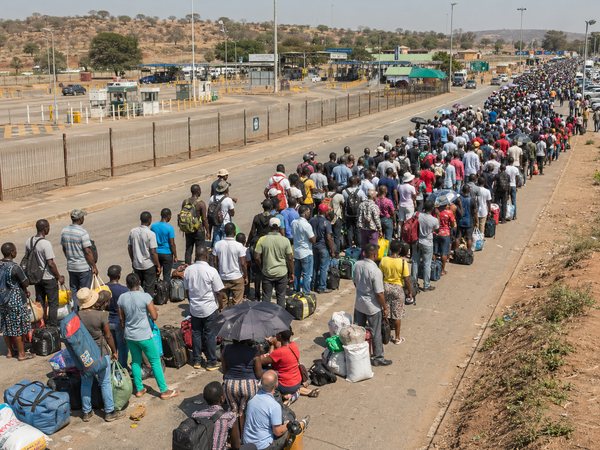
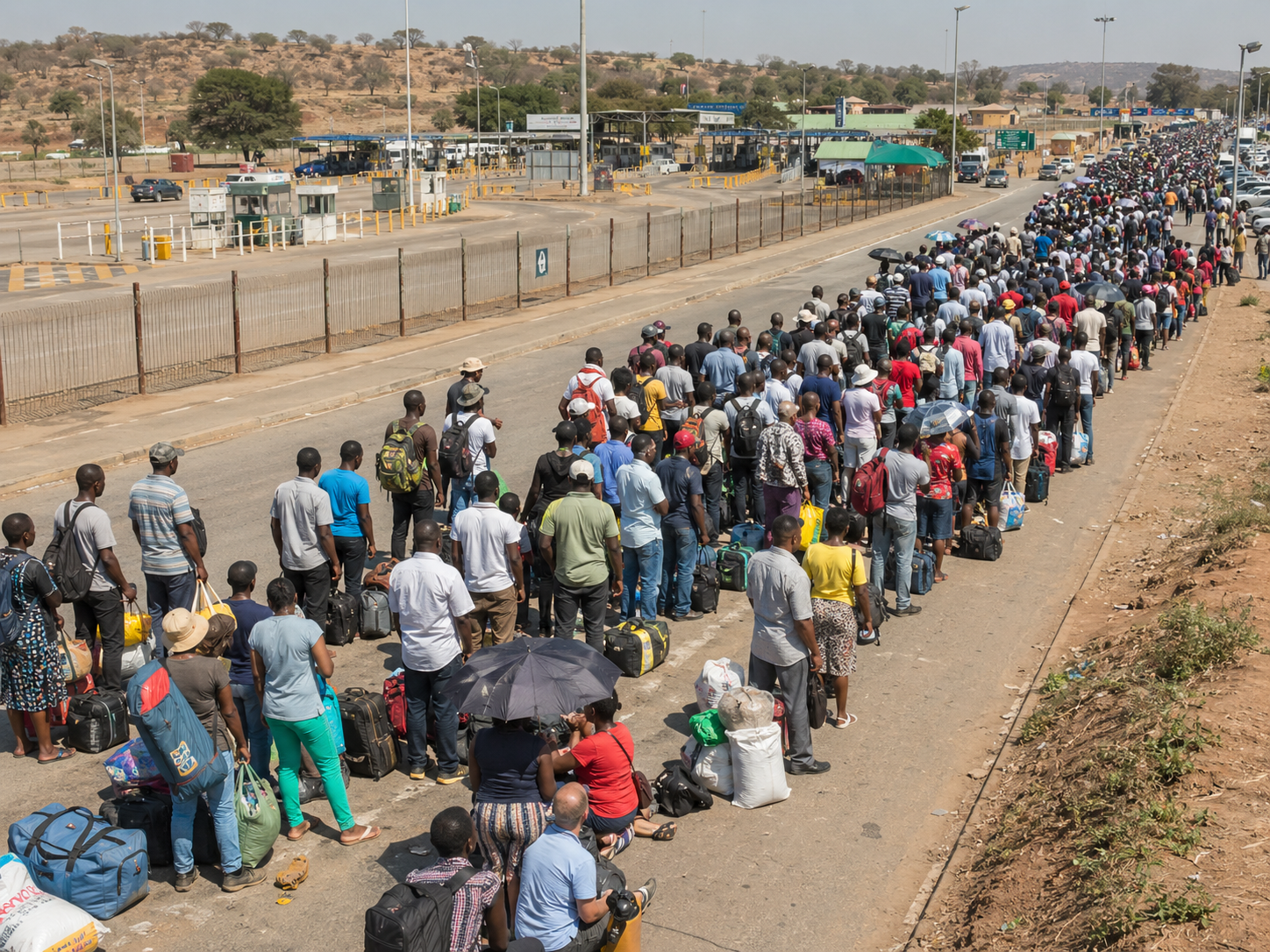
Since the early 2000s, tensions have developed as the number of immigrants from Zimbabwe has risen sharply. Botswana has long operated a Centre for Illegal Migrants at Francistown, its second-largest city, positioned close to the Zimbabwean border. By 2004, the country was deporting some 2,500 irregular Zimbabweans per month. That was at the height of Zimbabwe's hyperinflation crisis. The underlying economic conditions that drive emigration have not structurally resolved in the two decades since.
In December 2025, South Africa's Border Management Authority intercepted approximately 500 Zimbabwean nationals attempting to cross illegally via Botswana in just two days around Christmas — describing a clear shift in irregular migration routes toward Botswana's border crossings as South Africa intensified its own enforcement at Beitbridge.
The migration pressure along the Zimbabwe-Botswana corridor is not hypothetical. It is structural, ongoing and already large — before any border liberalisation has taken place.
Francistown and the Human Cost of Getting This Wrong
When members of Botswana's parliament raise concerns about removing passport requirements with Zimbabwe, they are not speaking in abstractions. They are thinking about Francistown — a real city, with real capacity constraints, that already functions as a frontline processing point for the movement of people along one of Southern Africa's most pressured migration corridors.
The concerns are specific. Housing, employment, public services — these are finite. When migration flows are moderate and managed, cities absorb them. When flows surge rapidly, the strain becomes visible, politically volatile and difficult to reverse. The concern in Botswana is not about movement in principle. It is about scale, pace and the absence of management infrastructure capable of handling a significant acceleration.
Research with Zimbabwean migrants in both Gaborone and Francistown documents a harder truth as well. Xenophobic attitudes are highly prevalent among Botswana's citizenry and within government, manifested in a range of negative stereotypes directed at Zimbabwean migrants in particular. This matters for the policy debate because some of the concerns being raised in parliament are not purely technical or procedural. They are the socially acceptable expression of something older and harder to address: a population that already feels economic pressure from Zimbabwean migration being asked to endorse a policy that would make that migration substantially easier.
"Xenophobic attitudes are highly prevalent amongst the citizenry and within government, manifested in a range of negative stereotypes. These stereotypes suggest foreigners pose threats to crime rates and the economic prosperity of Botswana — a narrative disseminated by the media, politicians and police."— Campbell & Crush, African Studies, 2015
None of this is an argument against integration. It is an argument for taking seriously the conditions under which integration succeeds versus those under which it becomes a source of political backlash that sets the entire project back. Southern Africa has already seen what happens when migration politics goes badly: xenophobic violence in South Africa has claimed Zimbabwean lives. Botswana has not gone there. Maintaining that record requires managing the pressures that lead there.
The Corridor at Night: Trafficking, Crime and the Document Gap
There is a conversation happening in the diplomatic suites about vision and integration. There is a different conversation happening on the ground, in the early hours, along the border fence.
Zimbabwe serves as a source, destination and transit point for human trafficking perpetrated by criminal networks operating along the route to South Africa, with Botswana forming a key transit corridor. Human trafficking and irregular migration from Zimbabwe are facilitated by complicit cross-border transporters and corrupt border management officials, particularly on the borders with South Africa and Botswana. The 2024 US Trafficking in Persons Report confirmed that Zimbabwe does not fully meet minimum international standards for the elimination of trafficking.
|
The trafficking dimension Women
and children from Zimbabwe are exploited in sex trafficking and forced labour
in agriculture, domestic services and mining — including in border town
economies on both sides of the Botswana frontier. Removing document
requirements without a verified digital alternative would reduce one of the
few remaining tools available for identifying and intercepting trafficking
victims at the crossing point. |
Zimbabwe has also emerged as a significant inland transit country for heroin, with smugglers transporting drugs overland from Tanzania and Mozambique toward South African and European markets — with Botswana featuring as a transit route in those networks. This is not an argument against border liberalisation. It is an argument for ensuring that liberalisation is matched by upgraded enforcement capability, not substituted for it.
The document verification problem is specific and serious. Zimbabwean national identity documents have historically been subject to forgery — a problem acknowledged in the academic and policy literature. Without a real-time, interoperable digital verification system capable of authenticating an ID at a border post instantly, removing the passport as a security layer creates a gap that criminal networks exploit far faster than governments can respond.
The Case for Opening: What the Region Stands to Gain
This article would be incomplete — and dishonest — if it did not make the affirmative case with equal clarity. Because the evidence for managed, well-resourced open borders in Southern Africa is real, and the economic argument for regional integration is not wrong.
According to a World Bank study, the full implementation of free movement within SADC could increase the region's GDP by 2.5% by 2030. For a region with persistent poverty and high youth unemployment, that growth translates into real livelihoods — not an abstraction. Intra-African trade currently accounts for only around 10% of total continental trade, well below intraregional trade in comparable developing regions. Administrative border friction is one of the measurable reasons why.
A 2025 peer-reviewed study examined the specific effects of free movement on cross-border trade in Zimbabwe within the SADC framework. Its finding was nuanced but ultimately positive: free movement of persons has a statistically significant short-run negative but long-run positive impact on cross-border trade. The disruption is real in the early phase. The benefits accumulate over time for countries that sustain the commitment. The political challenge is that governments rarely hold office long enough to harvest long-run gains while absorbing short-run costs.
For Zimbabwe, remittances from the diaspora — including those in Botswana — are already functioning as a critical economic lifeline. Some 53% of Zimbabwean migrants engage in informal activities as their primary income source, and remittances sent home are primarily used for daily survival rather than investment. Making those movements safer, more legal and more documented — rather than more clandestine — would benefit both sending and receiving communities.
|
The economic upside — SADC free
movement A
2025 study found free movement has a long-run positive impact on cross-border
trade in Zimbabwe. A World Bank analysis projects a 2.5% GDP uplift for SADC
from full integration. Intra-African trade stands at just 10% of total
continental trade — border friction is a measurable constraint on regional
growth. |
The question is never whether migration produces net benefit at a macro level — most evidence says it does. The question is who captures that benefit, who bears the costs, and whether governments have the capacity to redistribute the gains to those most exposed to the pressure.
· · ·
|
Coming in Part Three The
Reckoning: What has actually been agreed, and what must be done |