BCL mine employed thousands, built a town, and ran for 46 years. Then the government shut it down overnight — and left the mess for everyone else to clean up.
On 7 October 2016, Minister of Minerals Sadique Kebonang stood before the workers of Selebi Phikwe and told them BCL mine was finished. Operations would stop immediately. The mine was going into liquidation. A liquidator had already been appointed.
There was no warning. No negotiation. No consultation with the union. Vice President Mokgweetsi Masisi later drove to Phikwe to deliver the final word: "The train has already left the station. BCL is dead."
Nearly a decade later, thousands of former miners have still not been paid what they are owed. A government-funded liquidation has burned through over P1 billion. A Commission of Enquiry has only just begun to ask how this happened. And Selebi Phikwe — a town that copper and nickel built — is still trying to find its footing.
This is the full story. The origins. The decline. The collapse. And what, if anything, comes next.
Built on a political agreement
BCL — originally Bamangwato Concessions Limited — was created in 1956, and its foundations were as much political as geological. In 1959, a prospecting agreement was signed by African Authority Rasebolai Kgamane, alongside Seretse Khama and Oteng Mphoeng. The Selebi orebody was confirmed in 1963. Full mining operations began in 1973, after years of negotiations over ownership, profit-sharing and compensation to communities whose land was absorbed by the mine.
At launch, ownership was split between Anglo-American Corporation, the American firm Amax, and the Botswana government, which held 50 percent. The government was not just a shareholder. BCL was a development instrument — a bet that copper and nickel in the Eastern District could do for that region what diamonds would eventually do for the country.
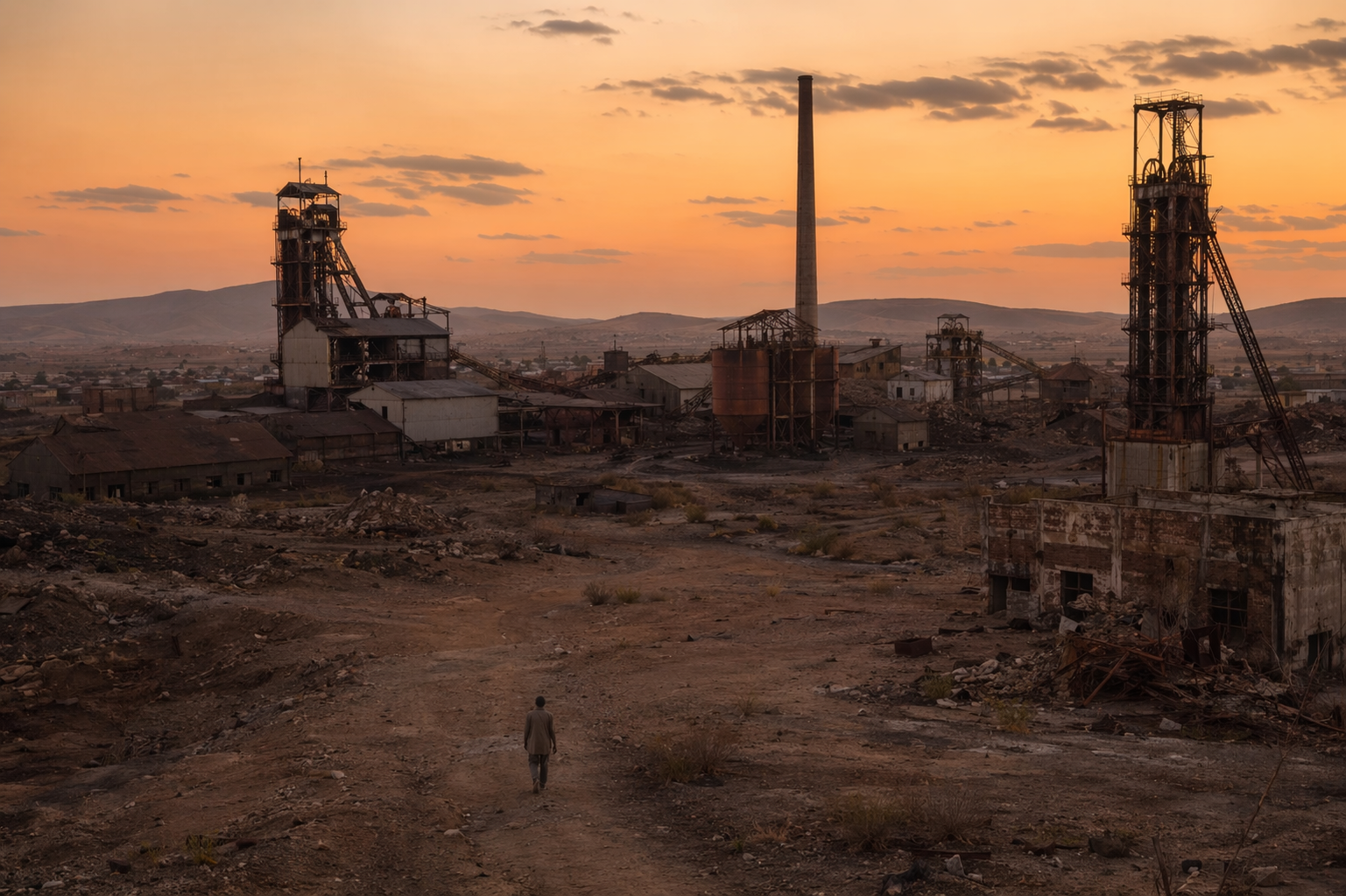
At its peak in the 1970s and 1980s, BCL was counted among the world's premier nickel mining complexes. The Selebi Phikwe operation ran multiple shafts and produced around 40,000 tonnes of nickel concentrate annually through the 1990s. It employed roughly 5,000 people directly. It built schools, clinics, staff housing, and a coal-fired power station. The town of Selebi Phikwe, in almost every meaningful sense, was BCL.
The long bleed
BCL's death was not sudden. It was slow, and — as critics have long argued — predictable.
The mine had been making losses for years, some estimates placing the monthly bleeding at between P50 million and P100 million in the final stretch. The smelting complex was expensive and technically troubled. Labour costs alone accounted for 40 per cent of total production. Ore grades were declining as mining went deeper. And commodity prices were cyclical in a way that BCL's cost structure could not absorb.
The warning signs had been visible for over two decades. As far back as 1991, the European Union had begun channelling money into Selebi Phikwe to fund economic diversification — loans under successive European Development Funds eventually totalling over EUR 60 million, converted to grants and sitting in a dedicated Re-employment Account of around 638 million Pula managed by the Selebi Phikwe Economic Diversification Unit (SPEDU). The money was meant to reduce the town's death wish-like dependence on the mine. It was largely unspent when BCL fell.
The final trigger was the Polaris II fiasco. In 2014, BCL agreed to buy Norilsk Nickel's 50 percent stake in South Africa's Nkomati nickel operation for US$337 million — a deal meant to secure concentrate supply for BCL's Phikwe smelter. When copper prices collapsed and BCL's finances deteriorated, the government pulled out. BCL formally withdrew from the Nkomati deal on 11 October 2016 — four days after announcing the mine's closure.
Norilsk was scathing in its response. "BCL was brought down not by a single project but by years of chaotic mismanagement," the company's spokesperson told The Botswana Gazette. The government has never offered a full rebuttal.
The workers government left behind
Before BCL closed, BMWU had a signed retrenchment agreement with mine management. Section 25 letters had been issued. The process was at an advanced stage.
Then government ordered the liquidation — and the agreement became worthless.
"The government of that time did not honour the agreement," BMWU president Joseph Tsimako told ministers in 2025. "We were caught off guard."
The government's legal position was that liquidation, as a process, did not trigger standard retrenchment protections. Workers and their union found this argument an obscenity. The same entity that ordered the liquidation — the government, as 100 percent shareholder — was now sheltering behind it to avoid paying.
"No matter what happens, the government has a duty to protect thousands of jobs at BCL." — MP Dithapelo Keorapetse, speaking to The Botswana Gazette, October 2016
Some 5,500 BCL workers lost their jobs. Add 700 at Tati Nickel Mine — which depended on BCL's smelter and was automatically killed by its closure — and an estimated 1,000 contractor workers not in the official count, and the total approaches 7,000 people thrown out of work in a single week.
The consequences went further than unpaid packages. Former miners later alleged to The Botswana Gazette that colleagues were dying from liver cirrhosis, linked, they believed, to years of underground exposure. They claimed BCL's medical clearance procedures at closure had been flawed, clearing workers who were already sick. The government did not respond to those allegations at the time.
A liquidation that became its own scandal
Liquidator Nigel Dixon-Warren was appointed in October 2016. From that day, he was averaging P2.2 million a month in fees. By 2018, MPs were told total liquidation costs had exceeded US$100 million — over P1 billion. The government was spending between P15 million and P20 million a month just to keep the mine on care and maintenance.
Dixon-Warren said it would take six more years to fully wind down BCL. He had received over 150 expressions of interest from potential investors and held serious talks with one or two.
Relations between the government and the liquidator eventually broke down. Minister Molale told parliament that an application had been filed to have Dixon-Warren removed. The government had also flipped its position — it now wanted BCL placed under judicial management rather than liquidation. The option critics had demanded at the very beginning.
Meanwhile, assets were stripped and sold. The Tati Phoenix Mine complex. BCL Farm. The Tati Laboratory Complex. The slag dump. The tailings dam. What had been a world-class mining complex was becoming a field of scrap metal. Dixon-Warren even flooded two BCL shafts without first seeking permission from the Department of Mines — a decision that triggered seismic tremors across Phikwe from 2018.
Minister Bogolo Kenewendo eventually delivered the verdict that nobody wanted to hear: "The majority of the assets have been stripped and sold for scrap. Phikwe as we know it will not happen."
The reckoning — and a fragile revival
Under President Duma Boko, there are signs that government is taking the BCL chapter more seriously than its predecessors did.
A Commission of Enquiry chaired by former Advocate Judge Malcolm Wallace has been established to investigate the closure and the asset disposal process. It began work in 2025. BMWU has warned that it must not become a mechanism for delaying payments to ex-workers who have now waited almost a decade.
Government also spent P300 million to buy back 1,642 BCL staff houses from the liquidator — stopping the auction of homes from under former miners still living in them. President Boko announced, at a kgotla meeting in Phikwe, that talks with Premium Nickel Resources Botswana (PNRB) on reopening the mine are at an advanced stage.
PNRB, backed by Canadian investors and headed by former BCL managing director Montwedi Mphathi, purchased the Selebi and Selebi North shafts from the liquidator in 2022. It has committed to injecting P5 billion into developing the infrastructure, with hundreds of jobs expected when production restarts. Drilling has identified promising mineralisation and a possible connection between the Selebi and Selebi North deposits at depth, which could significantly expand the resource base.
But the minister's own words are the necessary corrective to optimism. What PNRB builds will not be the BCL that Phikwe knew — leaner, more automated, far fewer jobs. The shafts that were flooded are gone. Much of the infrastructure was sold for scrap.
The real lesson of BCL
Botswana's development story is one of the continent's genuine success stories. BCL is the chapter that complicates it.
For 25 years before the 2016 closure, the government had the money, the international support, and the warnings needed to diversify Selebi Phikwe. It chose to keep BCL on life support instead — politically easier, commercially ruinous. When the bill could no longer be deferred, it was paid by the workers.
Those workers are still waiting. The packages. The medical accountability. The full truth of what happened and why.
Selebi Phikwe does not need more promises. It needs the retrenchment packages honoured, the Commission of Enquiry to deliver real findings, and an economic alternative that is built, not just planned.
The town has waited long enough.
Sources: The Botswana Gazette, Mmegi Online, Business Weekly & Review, IndustriALL Global Union, Sunday Standard Botswana, The Executive Botswana, EEAS EU Delegation, Premium Nickel Resources Ltd., Botswana Daily News.