Parliament passed Bill No. 14 of 2025. The hard questions did not go away with it.
On 30 March 2026, Botswana's National Assembly voted 50 to 15 to pass the Constitution (Amendment) Bill, 2025 — Bill No. 14 of 2025 — establishing the country's first dedicated Constitutional Court. The bill, initially gazetted in July 2025, amends Chapter VI of the Constitution to strip the High Court of exclusive constitutional jurisdiction and vest it in a new, specialist bench. It now heads to a national referendum, where registered voters will have the final say.
President Duma Boko and the UDC government describe this as a necessary upgrade — faster decisions, specialist expertise, stronger protection of fundamental rights. That case is not without merit. What it lacks is an honest engagement with the questions that ordinary Batswana have been asking since the bill was first published: Why now? At whose expense? And for whose benefit?
What the Bill Actually Does
The Constitution (Amendment) Bill, 2025 does one primary thing: it creates a Constitutional Court as the apex body for constitutional interpretation and review. Under the current system, the High Court hears constitutional matters alongside its general civil and criminal caseload. The Court of Appeal sits above it. Critics of that arrangement — and there are serious ones — argue that the dual mandate produces inconsistent rulings on rights questions, delays in complex constitutional cases, and an absence of the specialised jurisprudence that foundational law demands.
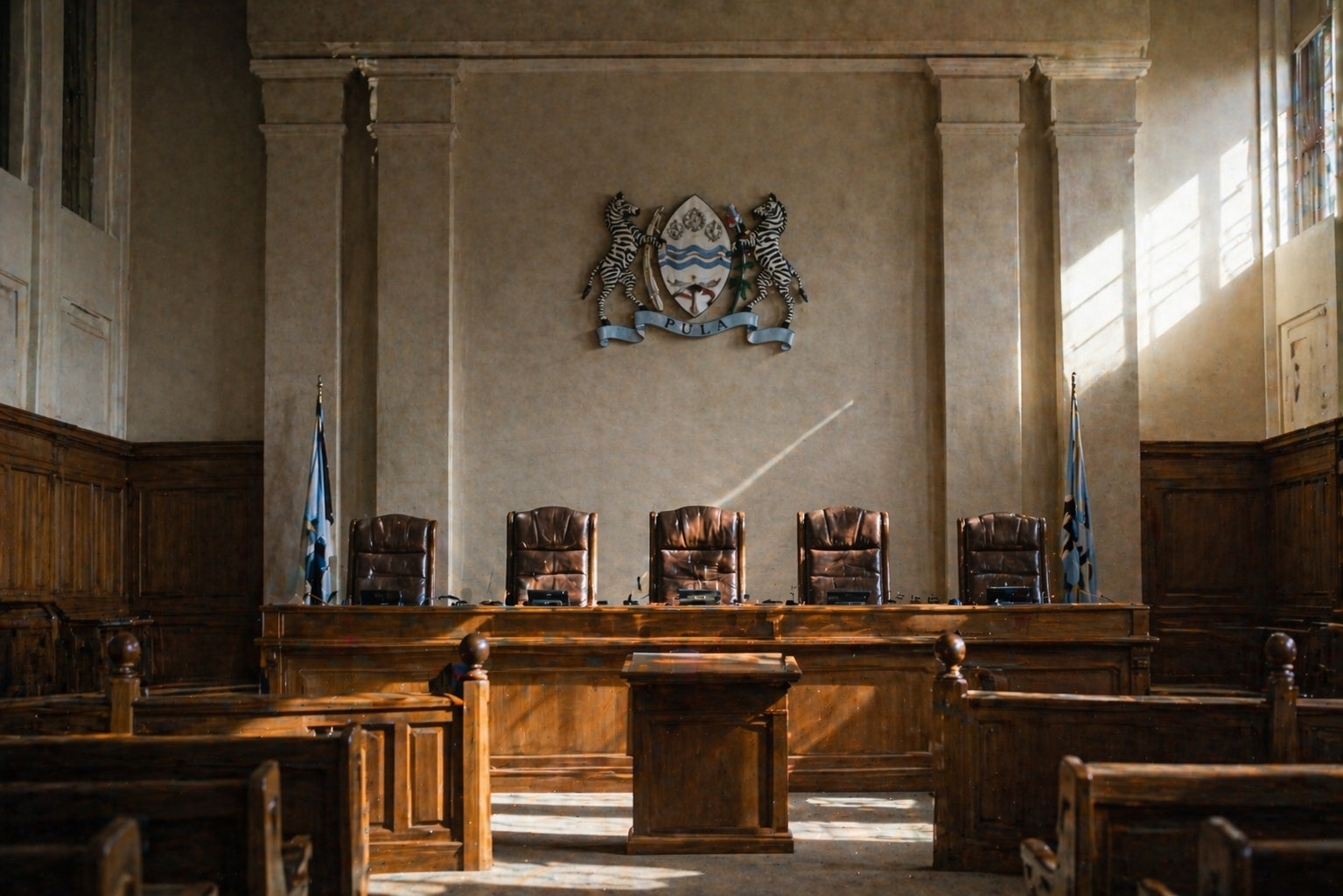
The ConCourt, as proposed, would have exclusive jurisdiction over the interpretation of the Constitution, the validity of laws, enforcement of fundamental rights, and disputes touching on elections and parliamentary processes. The rationale is coherence: constitutional questions decided by judges who do nothing else, building a consistent body of precedent over time. Supporters point to South Africa's Constitutional Court as the model — a court whose rulings have become some of the continent's most respected legal writing.
That is the vision. The question is whether Botswana's current moment — fiscal pressure, strained service delivery, and a public that is still waiting for the new government to deliver on its basic promises — is the right time to build it.
The Redundancy Problem — and Why It Is Not Easily Dismissed
The government's supporters will argue that the High Court's handling of constitutional matters has been demonstrably inconsistent, and they are not wrong to say so. Conflicting interpretations of fundamental rights provisions across different benches, judges rotating between constitutional and commercial work without specialist grounding, and the absence of a single authoritative voice on constitutional questions — these are real problems in any legal system that takes its constitution seriously.
But critics are equally entitled to point out that the Court of Appeal has functioned as Botswana's effective apex court for decades, including on constitutional matters, and that the country's reputation for judicial independence — genuine, hard-earned, and internationally respected — was built within that existing architecture. A new court does not automatically inherit that reputation. It has to build it, case by case, appointment by appointment. And the composition of that bench — who appoints, on what criteria, with what transparency — is precisely the kind of question that has not been answered publicly with the seriousness it deserves.
Wrong Priorities, or Both at Once?
The loudest objection from the public consultations was not a legal argument. It was a moral one. Hospitals run short of medicines. Roads in rural districts are impassable. Youth unemployment remains one of the most destabilising features of Botswana's economy. Against that backdrop, the government chose to spend — reportedly over P1.5 million on consultations alone — on establishing a new layer of the judiciary. Citizens did not reject the ConCourt outright. They asked, repeatedly and plainly, why this could not wait.
That is a legitimate question. It deserves a direct answer, not a press conference assurance. Government has the ability to do more than one thing at once — but it does not have unlimited political capital or unlimited public trust. Spending both on an institution whose benefits are, for most Batswana, entirely theoretical is a choice. It should be defended as one.
The Death Penalty Question No One Can Avoid
Because President Boko spent decades as a capital defence advocate — most visibly in his representation of Brandon Sampson, a Motswana sentenced to hang — many Batswana fear the ConCourt is a vehicle. Not for rights in the abstract, but for the abolition of capital punishment specifically, via judicial route rather than parliamentary debate.
On 16 January 2026, President Boko addressed this directly in the National Assembly:
"So do not be afraid that the ConCourt will be used to abolish the death penalty."
He similarly clarified that same-sex marriage would not be advanced through the new court, saying such matters remain governed by existing law and Botswana's legal and cultural framework.
The assurances were noted. They were not sufficient to close the debate — and they should not have been expected to. Trust is not declared. It is demonstrated. A president whose personal legal history is inseparable from his opposition to capital punishment cannot simply instruct the public not to draw the obvious line between that history and an institution whose design concentrates constitutional power in a small, appointed bench. Those concerns will persist until the court's actual jurisprudence — and the composition of its bench — either validates or refutes them.
Sovereignty, Cost, and Who This Serves
Botswana has built one of Africa's most stable democratic and institutional records through careful, incremental, home-grown decisions. That record was not built by copying what worked in Cape Town or Nairobi. It was built by Batswana, at Botswana's pace, according to Botswana's realities.
The ConCourt is not inherently foreign. But the urgency driving it — the pressure to establish a specialist constitutional court as a mark of democratic maturity — is a pressure that arrives with a particular international flavour. If the government has received donor encouragement, or if international institutional frameworks have shaped the timeline, those influences should be disclosed and debated, not folded quietly into a constitutional amendment.
Genuine judicial strengthening must include the courts Batswana actually use every day: magistrates' courts with proper resources, speedier case disposal, legal aid that reaches people who cannot afford private counsel. A Constitutional Court that produces landmark rulings on rights while ordinary Batswana wait years for civil disputes to be resolved will deepen, not address, public alienation from the legal system.
What Comes Next Cannot Be an Afterthought
The parliamentary phase is concluded. The referendum now determines whether the ConCourt becomes operational. If Batswana vote in favour, what follows — the appointment of judges, the rules of court, the budget and infrastructure — must be executed with a level of transparency that the process so far has conspicuously lacked.
BOCONGO's warning is the right one, even if civil society's call for withdrawal has been overtaken by events: the public must not be pushed into a referendum without understanding what they are voting for. The government's obligation now is civic education — real, substantive explanation of what this court will and will not do, what it will cost to run, and how its bench will be constituted and by whom. A yes vote secured through ignorance is not a mandate. It is a problem deferred.
Vision 2036 describes a Botswana of prosperity, built by Batswana and for Batswana. That prosperity does not begin with a new court. It begins with a child who can see a doctor, a young graduate who can find work, a road that holds through the rains. Institutions matter. The sequencing of them matters too.
Botswana's ConCourt is now the law. Whether it becomes a genuine pillar of justice — or an expensive monument to elite priorities — will be decided not by Parliament, but by what this government does next.
Sources
Parliamentary and legislative sources
- Constitution (Amendment) Bill, 2025, Bill No. 14 of 2025, gazetted July 2025
- National Assembly, Third Reading Vote, 30 March 2026: 50 Ayes, 15 Noes
Civil society
- BOCONGO discussion document on Bill No. 14 of 2025, Sunday Standard, April 2026
- Joint civil society statement: BOCONGO, Botswana Council of Churches, OAIC-Botswana, BOFEPUSU, BFTU, October 2025
Media
- Gabz FM News, "Constitution Bill Under Fire for Lack of Public Input," August 2025
- The 2nd Republic, "Botswana Parliament Passes Constitutional Court Bill," 30 March 2026
- The 2nd Republic, "Constitutional Court Bill Clears Parliament, Heads to National Referendum," 31 March 2026
- Sunday Standard, "Batswana Kept in the Dark Over ConCourt — BOCONGO," April 2026
- The Patriot, "Civil Society, Unions Warn Govt," December 2025
Enjoyed this piece? Subscribe to the Pula Dispatch — weekly commentary on Botswana politics, policy, and society, free in your inbox.