The government wants to build a P50 billion agricultural economy. Foot-and-Mouth Disease has other plans.
There is a version of Botswana's future that Vice President Ndaba Gaolathe has been selling hard.
In it, we are no longer just a diamond economy in slow decline. We are a continental agribusiness powerhouse — exporting processed beef, nutraceuticals, and high-value genetics to the EU, to Asia, to the world. We have lifted protectionist bans that made food expensive and made us uncompetitive. We have attracted investors. We have pivoted.
It is a compelling vision. Presented at the 2026 Botswana Agriculture Business and Investment Forum in Tlokweng in February, Gaolathe set the tone with characteristic bluntness: agribusiness is not charity work for struggling farmers. It is the engine that replaces diamonds.
The problem is that right now, a virus is dismantling that vision in real time. And the government's response raises serious questions about whether Botswana is equipped to pull off the pivot it has promised.
The Plan, In Brief
When the UDC government came to power, it inherited an agricultural sector that had been propped up by protection and undermined by neglect in equal measure.
The most visible symbol of this contradiction was the vegetable import ban — a policy introduced under the previous administration to shield local farmers from South African produce. Gaolathe demolished it without ceremony. In a parliamentary session that became something of a masterclass in applied economics, he called it what it was: "very bad economics." His logic was simple. Botswana is a small country. Protecting a domestic vegetable market that cannot possibly scale to national employment levels, while making food more expensive for low-income families in the process, is not development. It is performance.
His alternative: export-led agribusiness. Grow Botswana's cattle herd from 1.7 million — down from 2.2 million in 2011 — to 5 million in five years. Develop meat processing. Build seed production capacity. Invest in controlled-environment agriculture, freshwater fisheries, and fruit tree plantations. Create industries that sell to the rest of Africa and the globe, not just to Batswana.
The Ministry of Lands and Agriculture received a presidential directive to that effect. Investors were invited to a two-day forum. The National Development Plan 12 locked in agriculture as a priority pillar. The language of transformation was everywhere.
And then, almost immediately, the disease arrived.
What FMD Is — and Why It Is Not a Minor Inconvenience
Foot-and-Mouth Disease (FMD) is not a disease that kills cattle. It is a disease that kills markets.
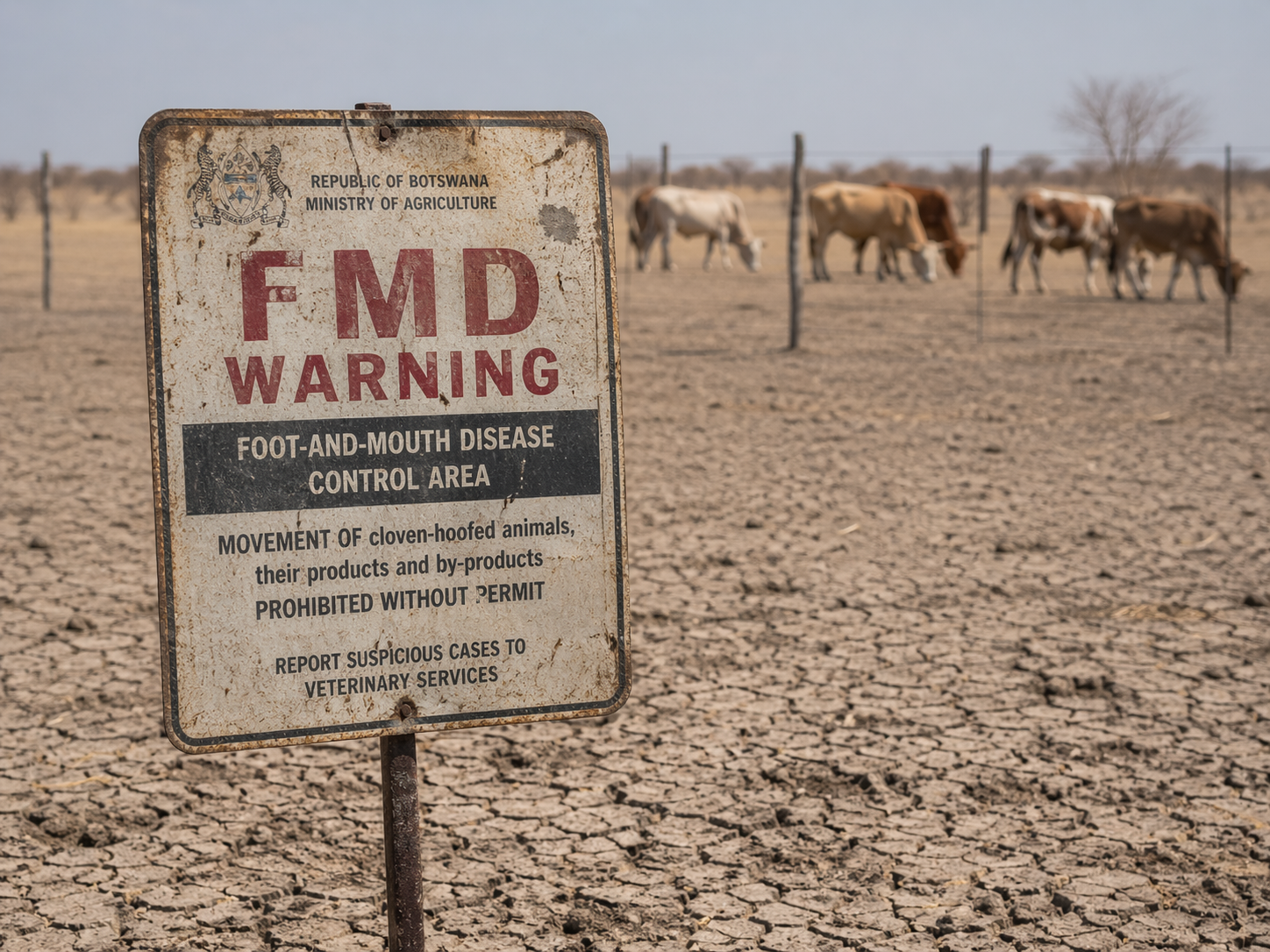
This distinction matters enormously. When FMD breaks out in a zone, the World Organisation for Animal Health (WOAH) suspends that zone's FMD-free status. Export markets — the EU, the UK, Norway — halt beef imports from affected areas, sometimes indefinitely. The economic damage comes not from dying animals but from closed doors. In a country where beef production accounts for up to 65% of agricultural sector revenue, and where roughly 80% of that beef is destined for European and South African markets, an FMD outbreak is not a veterinary problem. It is a fiscal one.
Botswana has known this for decades. FMD has been endemic in the country's northern zones since the 1930s, driven largely by the African buffalo — the natural reservoir of the virus — roaming communal grazing land along the Chobe and Ngamiland districts. The country's entire disease control architecture, its system of cordon fences, vaccination zones, and disease-free export corridors, was built specifically to contain this threat and protect the beef export business.
For years, it worked. Imperfectly, with recurring lapses, but it worked well enough.
This year, it stopped working.
How the Outbreak Unravelled
The first alarm came in January 2026. An FMD outbreak was confirmed in Zone 6b — part of Francistown — on 25 January. WOAH suspended that zone's free status immediately.
Then Zone 3c (Maitengwe) fell on 3 February.
Then, on 31 March, in a single sweeping notification to WOAH, Botswana reported outbreaks in the Barolong area of its southern district. In one move, the free status of a vast belt of territory — Zones 3c (Dukwi), 4b, 5, 6a, 8, 9, 10, 11, 12, and 13 — was suspended. These are Botswana's premium export zones. The zones from which beef goes to Europe.
The Botswana Gazette had, by early April, published the third statutory declaration of an infected area for 2026 under the Diseases of Animals Act. The "No. 3 Order" placed a wide corridor of southern territory — from the border near Phala Camp through Banyana Farms and across multiple districts — under strict disease control.
Then came the outbreak that should alarm every Motswana who is watching this situation carefully.
On 2 April, the Ministry of Lands and Agriculture confirmed FMD at the Ramatlabama National Artificial Insemination Laboratory and Training Centre — known as NAIL. This facility, in Goodhope district, is not just another cattle farm. It is the beating heart of Botswana's "Reset Agenda." Home to over 200 elite breeding cattle, NAIL was built to produce and distribute high-quality bovine genetics to farmers at subsidised rates — the foundational infrastructure for the 5-million-cattle ambition. If you want to understand what the government's agribusiness vision actually depends on, you look at NAIL.
And NAIL is now under quarantine.
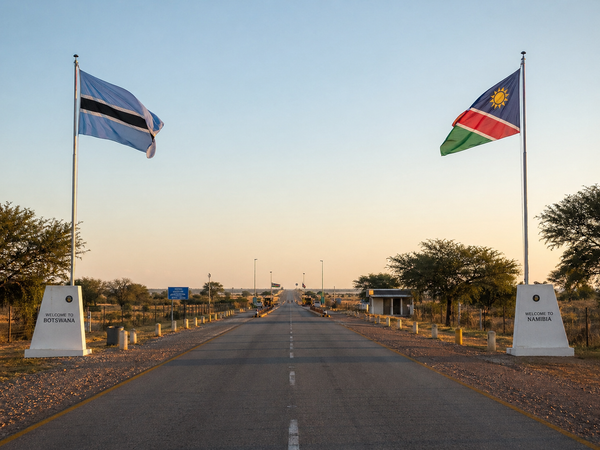
The facility sits less than 5 kilometres from the nearest confirmed FMD outbreak in South Africa. Two countries. One fence. A disease that survives on vehicles, boots, and feeding equipment.
In response to the NAIL outbreak, the Ministry suspended most of Botswana's beef exports — again. Only Zone 2 retains limited export permissions, and those are subject to each importing country's individual conditions.
The Vaccination Problem
FMD control depends on vaccination. But vaccination is where things get complicated — and politically contested.
Botswana's disease control system relies on a zoning model: some areas are "FMD-free with vaccination," others are "FMD-free without vaccination." That distinction matters enormously for trade. Many premium markets prefer, or even require, beef from zones where vaccination is not practised, because the absence of vaccination is taken as a proxy for the genuine absence of the virus. A vaccinated herd cannot definitively signal the same freedom from infection.
The 2026 outbreaks have now stripped "free without vaccination" status from nearly every major zone in Botswana. Restoration of that status — once the disease is controlled — is not a quick process. It requires surveillance, reporting, time, and negotiation with trading partners. Years, not months.
This creates a cruel paradox for the Reset Agenda. The government wants to transition Botswana from raw meat exporter to high-value agricultural genetics leader. That vision requires exactly the kind of premium market access that FMD — and the vaccination debate it triggers — can revoke in a matter of weeks.
The Structural Vulnerabilities Nobody Wants to Talk About
FMD is not just a bad run of luck. It is the predictable result of structural conditions that Botswana has never fully resolved.
The northern zones have always been porous. Communal grazing, wildlife corridors, buffalo movement, informal cross-border trade — these are not new phenomena. The cordon fence system that is supposed to separate infected wildlife zones from commercial cattle areas has, according to independent audits, suffered from chronic maintenance failures and inconsistent surveillance for years.
The cattle population itself tells a story. The herd has shrunk from 2.2 million to 1.7 million over the past fourteen years. Meanwhile, the government's ambition is to more than triple it in five. Anyone who knows anything about cattle farming, disease control, and land capacity should be asking hard questions about what disease infrastructure, what veterinary staffing, what surveillance capacity exists to support that scale of expansion — especially in the middle of a regional FMD crisis that has spread across South Africa, Zimbabwe, Eswatini, and Mozambique simultaneously.
The regional dimension is critical. The current wave of FMD across Southern Africa was first detected in South Africa in April 2025. Botswana shares long, porous borders with South Africa and Zimbabwe, both of which are active outbreak zones. South Africa has declared FMD a national disaster. Zimbabwe has confirmed outbreaks in Matabeleland South, directly along the Botswana border. The virus is not contained. It is circulating across an entire region, in communal herds, across informal trade routes, along fences that were not built to stop airborne viruses.
Botswana cannot solve this alone. And its disease control architecture was not designed for a regional crisis of this magnitude.
What the Government Has Right — and What It Is Getting Wrong
To be fair to Gaolathe and the UDC administration, the instinct behind the agricultural pivot is correct. Botswana's dependence on diamond revenue is unsustainable. Agriculture — particularly livestock and agro-processing — represents one of the few sectors where the country has genuine comparative advantage: land, existing herds, established EU market relationships, and a reputation for quality beef that its competitors would envy.
The decision to lift the import ban was also right, even if it was politically costly. Protecting uncompetitive domestic producers at the expense of poor consumers is not economic policy. It is electoral theatre. Gaolathe was correct to call it out.
The vision of an export-oriented, high-value agribusiness sector is achievable — in principle.
What is not yet clear is whether the government has matched the ambition of the vision with the rigour of its execution. An investment forum is not a veterinary response plan. A presidential directive to multiply the cattle herd does not come with a roadmap for the disease infrastructure needed to protect it. Announcing priorities in NDP 12 does not fix the cordon fences in Zone 6b.
The NAIL outbreak is the most damning symbol of the gap between aspiration and readiness. Here is the facility that is supposed to anchor the genetics transformation at the heart of the Reset Agenda — and it has been brought down by a virus that crossed a 5-kilometre border. That is not a freak event. That is a failure of biosecurity, surveillance, and cross-border coordination.
The Rural Stakes
It is easy, in the language of investment forums and export strategies, to forget who actually bears the cost when these systems fail.
It is the communal farmer in Ngami land who watches livestock movement controls freeze his ability to sell. It is the commercial rancher in Zone 11 whose EU contracts evaporate overnight when WOAH suspends export status. It is the rural household in Barolong whose livelihoods are tied to cattle — not as assets in a transformation plan, but as the actual basis of life.
Agriculture contributes less than 2% of GDP. But it is the foundation of the rural economy in ways that GDP cannot measure — social capital, food security, intergenerational wealth, cultural identity. When the government describes the sector as an engine for diversification, it is making a macroeconomic argument. When the farmer in Goodhope watches NAIL go into quarantine, he is experiencing something else entirely.
The government's agricultural pivot will only succeed if it takes both of those realities seriously at the same time.
The Bottom Line
Botswana is attempting something genuinely ambitious: to transform a livestock sector weakened by disease, declining herd numbers, and years of policy drift into a modern agribusiness engine capable of competing on the world stage.
The vision is correct. The urgency is justified. The liberalisation of import bans was the right call.
But the 2026 FMD crisis has exposed the fragility beneath the ambition. Three infected area declarations in a single year. Nearly every export zone stripped of its WOAH-recognised free status. The country's premier genetic facility under quarantine. Most beef exports suspended.
The Reset Agenda cannot reset a broken disease control system by simply declaring a new direction. It requires investment in veterinary infrastructure, surveillance capacity, cross-border coordination with South Africa and Zimbabwe, and an honest reckoning with what it will take — in time, money, and institutional capability — to restore Botswana's standing as a reliable, disease-free beef exporter.
VP Gaolathe has been right about the economics. The harder test is whether this government can also get the veterinary politics right. Because right now, the disease is winning — and the dream is losing ground, one zone suspension at a time.