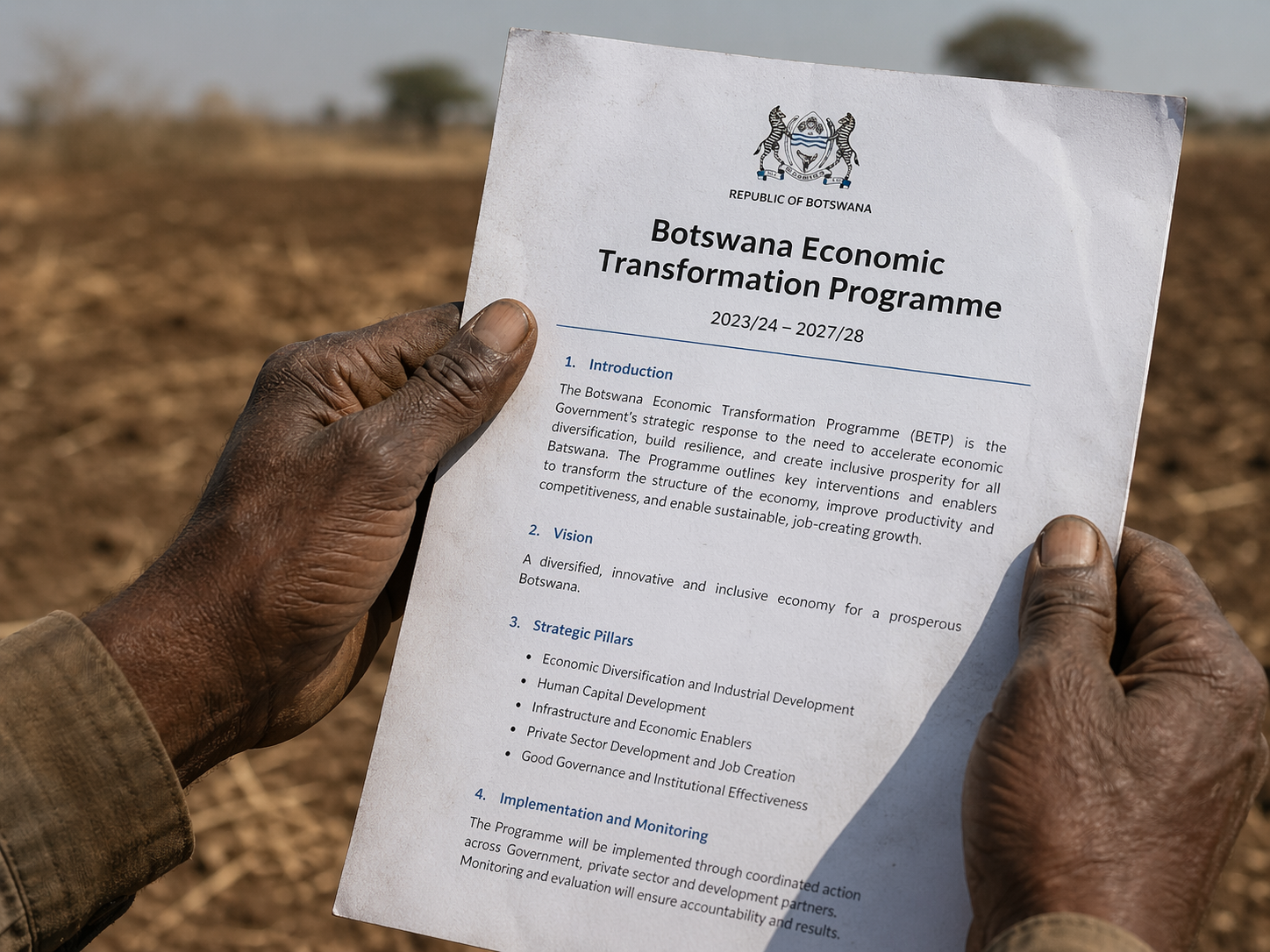
The Ministry of Finance has published Botswana’s Economic Transformation Programme. It has four pillars, a catchy slogan, and a Presidential Delivery Dashboard. It does not yet have a single line that tells a 27-year-old in Block 8, or a widow farming in Mahalapye, or a mechanic in Selebi Phikwe exactly what changes for them on Monday morning. This is that article.
Gaborone, April 2026. The Ministry of Finance website now carries a page titled “Botswana’s Economic Transformation Programme (BETP): Forging a Resilient Future.” It is the government’s formal answer to the question Batswana have been asking for three decades: what comes after diamonds?
The document is written in the language that governments speak when they want to sound bold without committing to anything specific. Words like pivot, anchor, catalyse, resilient, and knowledge-driven appear throughout. The goals are enormous. The timelines are vague. The human beings the policy is supposed to serve appear nowhere.
That is not unusual for a government policy document. What is unusual — and what this moment in Botswana’s history demands — is that citizens read these documents, understand what they actually say, and hold the government accountable for the distance between the language and the reality.
So let us do that together.
What the Government Is Actually Saying — In Plain Language
The BETP rests on four pillars. Here is what each one means, stripped of the jargon.
Pillar One: Stop depending on diamonds. Build other industries instead.
The government wants to grow the economy through tourism, financial services, technology, and manufacturing — sectors that are not tied to what comes out of the ground. This is the right direction. It is also, almost word for word, what Vision 2016 said. And Vision 2036. And the National Development Plans before them.
The goal is described as creating “globally competitive institutions and high-value jobs.” What that means in practice — which industries, how many jobs, by when, for whom — is not specified in the document.
Pillar Two: Make Botswana the financial capital of Southern Africa.
The government wants international banks, investment funds, and financial companies to use Botswana as their regional base — the way Mauritius is used for East Africa, or Singapore for Southeast Asia. The pitch is that Botswana has stable politics, a functioning legal system, and a clean regulatory record.
These are real advantages. They are also advantages Botswana has had for forty years without becoming a financial hub. The document does not explain what will be different this time.
Pillar Three: Use our reputation to attract investors.
Botswana’s strongest assets are its political stability, its independent courts, and its record of relatively clean governance. The BETP wants to leverage these to pull in private capital — foreign and domestic — and make it easier to start and run businesses here.
Again, correct instinct. The question is specifics. “Ease of Doing Business” has been a stated priority in Botswana for more than twenty years. Today, setting up a company still takes longer than it should. Getting a work permit still takes longer than it should. Accessing land for a business still takes longer than it should. The aspiration is not new. The implementation record is what needs to change.
Pillar Four: Reform the public service and make it deliver.
This is the most interesting pillar — and the most honest admission in the entire document. It proposes adopting “Big Fast Results” methodology, establishing a Presidential Delivery Dashboard for real-time accountability, and turning the public service into what the document calls a “fast and fearless execution machinery.”
Translation: the government is acknowledging that Botswana’s public sector is slow, risk-averse, and poor at delivering results. And it is proposing to fix that by borrowing a results-tracking model — one originally used in Malaysia — that holds senior officials accountable to specific targets in specific timeframes.
This is the right diagnosis. Whether the cure will work depends entirely on what happens when officials miss their targets.
What Is Missing From the Document
The BETP also lists what it calls key enablers — the things that will make the four pillars possible. They are: value chain development in minerals, tourism, agriculture and education; digitalisation; mindset change; and NDP 12 as the five-year execution plan.
Read together, these paint a picture of what the government believes needs to happen. What the document does not provide is the picture of who benefits — and how.
There is no mention of the subsistence farmer in Serowe who cannot get her goat meat into a cold chain and therefore cannot sell to a supermarket or export it. There is no mention of the school leaver in Maun who has a smartphone but no reliable internet connection and therefore cannot access the digital economy. There is no mention of the small business owner in Francistown who needs a bank loan to grow but cannot meet the collateral requirements of any commercial bank in the country.
The BETP is written for investors and international audiences. That is understandable. But a transformation that works for Batswana — not just for foreign companies setting up in Gaborone — requires a different level of specificity. It requires asking, at every stage of every policy: who does this actually reach?
The Critique: Four Real Problems This Document Does Not Solve
1. Services economies require workers who are ready for them — and Botswana’s are not, yet.
Tourism, financial services, and ICT are all good sectors. They are also sectors that require specific skills: hospitality management, data analysis, software development, financial modelling, customer experience design. The education system Botswana currently operates does not reliably produce these skills at scale.
The BETP says nothing about how the skills gap will be closed before the jobs it promises arrive. If foreign companies move their operations to Gaborone and then import their workforces from South Africa or Zimbabwe because Batswana candidates are not ready — that is not transformation. That is a new version of the same problem.
Suggestion: Before announcing sector targets, publish a skills audit. Tell Batswana how many graduates currently qualify for the jobs the BETP is trying to create. Fund the gap. Expand BIUST and the Botswana Accountancy College. Partner with industry to design curricula that match what the market actually needs — not what the 1990s thought it would need.
2. “Regional Financial Hub” is a competition Botswana has not yet entered seriously.
Mauritius has been building its financial services offering for thirty years. It has a specific legal framework for offshore companies, a network of double taxation agreements with 46 countries, a dedicated financial services regulator, and a visa regime designed for financial professionals. Rwanda is building fast. South Africa already has the Johannesburg Stock Exchange and the depth of capital market infrastructure that comes with it.
What is Botswana’s specific offer? The BETP says: political stability and a good legal system. Those are necessary conditions. They are not sufficient. Every serious investor also asks about double taxation agreements, capital repatriation rules, currency convertibility, and the depth of the local professional services market.
Suggestion: Commission a competitive analysis of what Mauritius, Rwanda, and South Africa offer financial services firms that Botswana currently does not. Build the specific legislation, regulatory incentives, and infrastructure to close those gaps. Target fintech companies and impact investors who are underserved by existing hubs — do not try to be Mauritius. Be the thing Mauritius is not.
3. The Presidential Delivery Dashboard will only work if ordinary Batswana can see it.
The concept of a delivery dashboard is genuinely good governance if implemented correctly. The idea is that every minister, every department, every programme has specific targets, and progress toward those targets is tracked visibly and in real time. When things slip, someone is held accountable.
The problem is: accountable to whom? If the dashboard is an internal government tool that senior officials see and citizens do not, it is performance management. If the dashboard is public — if any Motswana can go online and see that the Ministry of Health committed to building three new clinics in Ngamiland by December 2026 and has built zero — then it is accountability. Those are not the same thing.
Suggestion: Make the Presidential Delivery Dashboard genuinely public. Publish it online with monthly updates. Include the name of the official responsible for each target. Create a mechanism — a hotline, a public portal, a parliamentary committee — through which citizens can flag when targets are being missed. A dashboard that only the President can see is a spreadsheet. A dashboard that Batswana can see is democracy.
4. “Mindset Change” is not a government programme. It is the result of getting incentives right.
The BETP lists “mindset change” as one of its key enablers — “instilling a culture of urgency, accountability, and entrepreneurship across all sectors.” This is the part of the document that deserves the most honest critique.
You cannot instil a culture of urgency in a public servant who knows they cannot be fired, whose salary is guaranteed regardless of results, and who has watched twenty years of colleagues face no consequences for non-delivery. The mindset follows the incentive. Change the incentive, and the mindset moves with it.
Suggestion: Stop talking about mindset. Start changing the structures that reward the wrong behaviour. Introduce real performance consequences in the public service. Reform the CEDA and LEA lending models to reach early-stage entrepreneurs who have ideas and no collateral. Change government procurement rules to reserve a meaningful percentage of contracts for small Batswana-owned businesses. When the structures change, the culture will follow.
What Could Actually Work — And For Whom
Agriculture value chains — the most direct path to mass benefit. The BETP mentions agriculture as a priority sector. Good. But transforming agriculture in Botswana requires four specific things the document does not mention: water access and small-scale irrigation, cold chain infrastructure to get produce from farm to market without spoilage, market linkages connecting smallholder farmers to supermarkets and export buyers, and land tenure reform that gives communal farmers the security to invest in their plots. These are not glamorous. They do not make good press release photos. They are the difference between a policy and a meal on the table.
Digitalisation must reach the village, not just the capital. Right now, rural Botswana has inconsistent mobile data coverage, limited electricity access in remote areas, and very low levels of digital literacy among older adults. A digital economy that functions only in Gaborone and Francistown is not a national transformation. It is a two-tier society with better branding. Universal connectivity must be a prerequisite — not an afterthought.
The financial hub must create jobs for Batswana, not just offices for foreigners. If international financial companies set up in Gaborone and employ predominantly expatriate professionals, the economic benefit to ordinary Batswana is largely indirect. The financial hub ambition must come with explicit local employment targets, training pipelines, and partnership requirements that force knowledge transfer to Batswana staff.
NDP 12 must be readable by a Standard Eight student. When it is published, it should include a plain-language summary — one page, in Setswana and English — that any Motswana can read and understand: what the government is committing to, by when, and what citizens can do if those commitments are not kept.
The Slogan and What It Requires
The BETP’s rallying call is “Reset and Reclaim.” It is a good slogan. It acknowledges that something went wrong and signals intent to take it back.
But reset from what, exactly? The document frames the problem as diamond dependence and bureaucratic inertia. Both are true. What it does not name — and what Batswana deserve to have named — is the political economy that created those conditions. Diamond dependence did not happen by accident. It happened because the incentives for the ruling party of the time favoured stability over transformation, and because the people who controlled the resource had no political reason to build anything that would outlast their own dominance.
“Reset and Reclaim” is only meaningful if it means resetting that political economy — not just reshuffling the sectors in a policy document.
Reclaiming Botswana’s future means building institutions strong enough to survive bad governments. A civil service that delivers regardless of who wins the election. A private sector that does not depend on government contracts to survive. An education system that produces people who can compete globally.
That is a transformation. What the BETP currently describes is a plan for a transformation. Those are not the same thing.
The Questions the Dashboard Must Answer
If the Presidential Delivery Dashboard is real — public, with teeth, publishing results monthly — here are the questions it must be able to answer within twelve months:
How many new jobs — not “opportunities,” not “potential positions,” but actual, paying jobs — have been created in the priority sectors since the BETP was launched?
What percentage of new financial services licences issued have gone to Botswana-citizen-owned entities?
What is the rural internet coverage rate now versus at the start of the programme — and what is the target?
How many smallholder farmers have been connected to formal market channels through the value chain development initiative?
How many government departments have met their NDP 12 targets in the first two quarters — and what happened to those that did not?
If the dashboard cannot answer these questions — or if it answers them in language that requires a PhD to decode — then it is not a delivery tool. It is a communications strategy.
The Bottom Line
The Botswana Economic Transformation Programme is the most formally structured attempt this country has made to answer the question of what comes after diamonds. The four pillars are broadly correct. The instinct to reform the public service is overdue and right. The commitment to a delivery dashboard, if genuine, could change how government works in this country.
What the BETP currently lacks is the specificity, the honesty, and the human grounding that would make it a plan for Batswana rather than a plan for Botswana-the-brand.
Transformation is not a rebranding exercise. It is not the language on the Ministry of Finance website. It is not the slogan at the press conference.
It is Kabo in Block 8 getting a job that uses his engineering degree. It is the farmer in Mahalapye getting her beef into a cold chain and onto a supermarket shelf. It is the student in Maun getting fibre internet and a curriculum that teaches her to write code. It is the civil servant in Lobatse knowing that if she delivers, she will be recognised — and if she does not, there will be consequences.
Until the BETP produces those outcomes — and until there is a public mechanism through which Batswana can verify that it is doing so — it remains what its predecessors were: the right words, in the wrong hands, with the wrong level of urgency.
“Reset and Reclaim” is a promise. Batswana will be watching to see if it is also a plan.
The dashboard must be public. The targets must be specific. And the consequences must be real. Anything less is just another document on a government website.
Sources
Ministry of Finance, Botswana Economic Transformation Programme (BETP), finance.gov.bw; Ministry of Finance Budget Speech 2025/2026; IMF 2025 Article IV Mission to Botswana; World Bank Botswana Country Overview; Afrobarometer Dispatch No. 818, July 2024; IFC Country Private Sector Diagnostic: Creating Markets in Botswana; Commonwealth Secretariat Global Youth Development Index 2023; Business Weekly & Review Botswana; Mmegi Online.