Botswana Hangs People. Is It Time to Stop?
The case for and against capital punishment in a democracy that prides itself on getting things right
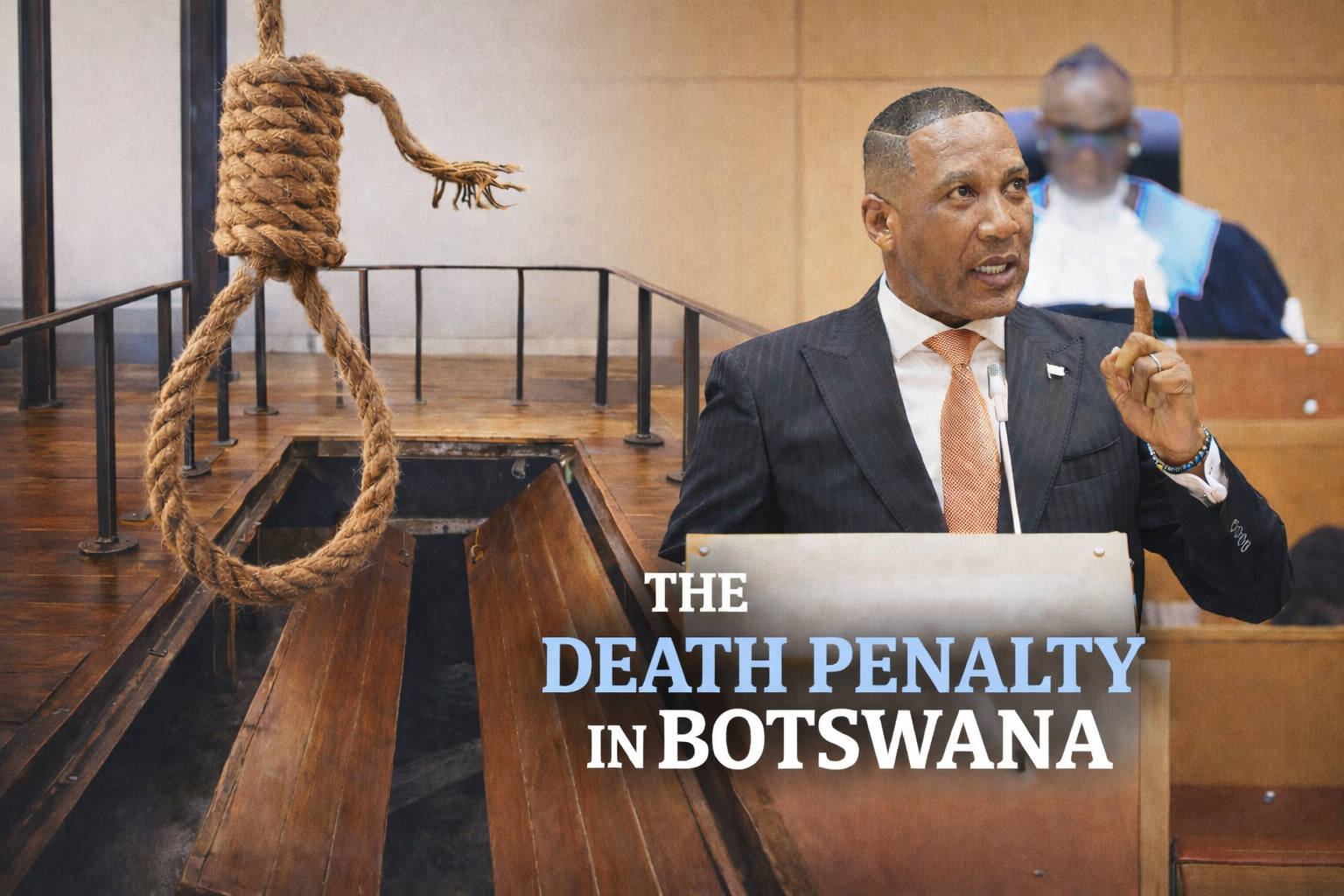
Few questions in public life resist easy answers more stubbornly than this one. Capital punishment sits at the intersection of justice and morality, of democratic consensus and human rights. Botswana has not avoided that question. It has simply answered it — quietly, behind prison walls, with a rope.
Gaborone Central Prison has seen dozens of executions since independence. The method is hanging. The process is secret. Families of the condemned are frequently not informed in advance. And successive governments have defended every aspect of this with calm, democratic confidence.
As a new government opens the door to policy review, the death penalty deserves serious, dispassionate scrutiny. Not the performance of outrage imported from European capitals, and not reflexive defensiveness either. A real accounting: what are the strongest arguments for keeping it, and what are the strongest arguments for ending it?
What the Law Actually Says
The legal basis for capital punishment in Botswana is found in the Penal Code (Chapter 08:01). The relevant provisions are unambiguous.
Section 202 defines murder. Section 203 prescribes the consequence:
203(1): Any person convicted of murder shall be sentenced to death.
203(2): Where the court finds that there are extenuating circumstances, it shall not impose the death sentence but shall impose a sentence of imprisonment of not less than 15 years, or life imprisonment.
The 15-year minimum in subsection (2) is a 2018 amendment — before that, courts had broader discretion. The effect of section 203(1) is a mandatory death sentence in the absence of extenuating circumstances. The judge has no option. Conviction without extenuation means the rope.
Capital punishment extends beyond murder. Section 34 prescribes death for treason. Section 35 prescribes it for instigating a foreign invasion. Section 63 covers piracy with the intent to kill. Under the Botswana Defence Force Act, certain military offences, including cowardly behaviour, also attract the death penalty. These are not theoretical. They are live provisions of Botswana law.
Section 26 of the Code governs how the sentence is carried out — by hanging at Gaborone Central Prison.
What Parliament Was Told
On Thursday, 13th March 2025, the National Assembly took up the question directly. Leepetswe Lesedi, MP for Serowe South, directed a series of pointed questions to Minister of Justice Nelson Ramaotwana. He wanted to know whether a moratorium had been imposed, why no death warrants had been signed since October 2024, and why the government appeared to be prioritising the rights of condemned prisoners over those of their victims.
Minister Ramaotwana reaffirmed the government's commitment to upholding the law as interpreted and applied by the courts. He acknowledged the death sentence as a legitimate punishment enshrined in the Penal Code. He stated unequivocally: "Neither the president nor the government has declared a moratorium on the death penalty."
He disclosed that there are 19 prisoners on death row. Of the 19, six have been through the Court of Appeal — four whose appeals were dismissed before October 2024, and two dismissed in 2025. Following the dismissal of their appeals, these prisoners submitted applications for mercy. No decision has been made on any of the representations yet.
Buried in those figures is a detail the minister himself flagged as critical. "It has come to light that three of the six applicants were not heard by the Court of Appeal — rather, the court dismissed their appeals on the ground that they had not filed their appeals on time." Three people currently awaiting execution have never had the substance of their cases reviewed by Botswana's highest court.
The minister also revealed that 417 individuals are currently held on remand for murder or manslaughter, with 238 of those admitted after October 2024 — a 57% increase since the new government took office. That sharp rise is what MP Lesedi was pointing to when he challenged the minister on whether the absence of signed death warrants was emboldening violent criminals.
The President: A Complicated Position
The man who sits at the centre of this debate is not a neutral actor. Duma Boko has consistently and publicly opposed the death penalty throughout his career as a human rights lawyer, arguing that capital punishment does not serve as a deterrent to the rise in murder cases.
His views were never hidden. In 2011, while representing Brandon Sampson — a Motswana sentenced to death alongside South African co-accused Michael Molefhe after the two were convicted of murdering two Zimbabwean nationals in Mogoditshane — Boko told Inter Press Service: "I am against the death penalty for many reasons, one of them being the sheer irrevocability of the sentence of death. You can't revoke it." He also said that as president he would refuse to sign death warrants regardless of what the law said: "Of course, when I am at the helm of that government, I will not sign anybody's death warrant whether the law says so or not. It is a position for which I don't apologise because it is a principled position."
That was 2011. In March 2026, the picture is more complicated. President Boko publicly refuted allegations that he opposes the death penalty, saying the Clemency Committee has not yet recommended any executions for his consideration and that as a lawyer he is obligated to respect and implement the laws of the land.
This is a politician navigating a difficult space. He has not signed a death warrant. He has not declared a moratorium. He has not publicly reversed his long-held convictions. What he has done is govern a country where 82% of citizens support the practice he privately opposes — and chosen, for now, to say very little.
Whether the Batswana who voted for him in 2024 wanted abolition is a legitimate question. But it sits alongside an uncomfortable counterpoint: that very same electorate, when surveyed in July 2024, supported capital punishment at 82%. Both things are true. Botswana elected a man who has spent his career opposing the death penalty, and those same voters overwhelmingly support it. How his presidency resolves that contradiction remains to be seen.
The Brandon Sampson Case: A President Tested by His Own Convictions
No case illustrates the stakes of this debate more personally for the current president than that of Brandon Sampson. In 2007, Sampson and his South African co-accused Michael Molefhe were convicted of murdering two Zimbabwean men — Sam Humbarube and Robert Ncube — in Mogoditshane village, just outside Gaborone. Both were sentenced to death at Lobatse High Court.Duma Boko, then leader of the opposition BNF, took on Sampson's case. He did not take it quietly. He used it as a platform to publicly challenge capital punishment in Botswana's legal system at a moment when few politicians dared. The appeal was heard on April 15, 2011. According to information provided to Pula Perspective, Sampson subsequently received a 20-year prison sentence — his life spared by the very man who now holds the power of clemency over the 19 people currently on death row. (Note: the specific sentencing outcome of the 2011 appeal could not be independently verified from published sources at the time of publication.)
The case is a study in what the system can do when it works — and a reminder of how heavily that depends on access to skilled, committed advocacy.
The Case for Retention
More than eight in ten Batswana — 82% — believe that the death penalty is an appropriate form of punishment for the most serious crimes, such as murder. Only 16% believe it is never justified. These numbers come from a nationally representative sample of 1,200 adult Batswana interviewed in July 2024, with a margin of error of plus or minus 3 percentage points.
The breadth of that support matters. Women at 86% are more likely to support capital punishment than men at 77%. Older citizens at 85% are more supportive than the youngest adults at 75%. Support is essentially equal between urban and rural populations. This is not a regional quirk or a rural traditionalism. It cuts across gender, age, and geography.
In a democracy, that matters. Those who advocate abolition from abroad often speak as if democratic consensus is irrelevant when it conflicts with their preferred norm. It is not. Botswana's government does not impose capital punishment despite its people. It administers it, in some meaningful sense, on their behalf.
The judicial process is also more rigorous than critics typically acknowledge. Defendants may appeal to the High Court and Court of Appeal. The judiciary — genuinely independent — has overturned death sentences. The president retains clemency powers. When retention advocates invoke due process, they are describing real procedural safeguards, not providing cover for state brutality.
Then there is the deterrence argument — often dismissed by abolitionists, but not so easily dismissed by those who live and work inside the criminal world. In an interview on the Case by Case podcast, Seabe Ramoruswana, a now-reformed ex-convict, described what he observed in criminal circles: that South African criminals had long been known to consciously avoid committing killings in Botswana precisely because the death penalty was applied here. (This claim is attributed to Ramoruswana's account on the podcast and has not been independently verified by Pula Perspective.) It is anecdotal. It is a single voice. But it is a voice that comes from inside the world academic criminologists rarely access — and it should not be dismissed simply because it is inconvenient to the abolitionist argument.
Finally, the moral intuition behind retributive justice is serious and widely held. A person who plans and carries out the murder of another has, in this view, forfeited their claim to remain among the living. To imprison them for twenty years and release them is not justice. It is management.
The Case for Abolition
The irreversibility of execution is incompatible with the irreducible fallibility of justice. No system, however excellent, is infallible. Evidence can be misread. Witnesses lie. Judges err. Capital punishment permanently eliminates the possibility of remedy. A wrongfully imprisoned person can be freed. A wrongfully executed person cannot be brought back.
A state proud of its judicial integrity should be precisely the state most troubled by what the case record shows. According to a 2024 paper in the Statute Law Review by University of Botswana law lecturer Baboki Jonathan Dambe, the Court of Appeal has set aside death sentences in no fewer than twenty reported cases — including cases where it acquitted accused persons already sentenced to death by the High Court. In Maselwa v The State, the Court found that the reasonable possibility of the accused person's innocence had not been excluded. The system caught them — but only because they appealed.
That is the problem. In 2022, in Pholo v The State, the Court of Appeal struck down Rule 44 — the provision requiring automatic review of every death penalty case regardless of whether the condemned person appealed. As the parliamentary record of 13th March 2025 confirms, three of the nineteen people currently on death row have never had the substance of their cases reviewed by the country's highest court. They missed deadlines. The safeguard that might have caught them is gone.
Appearing on Botswana Tonight, legal specialist Kgosi Ngakagae, who is now reported to serve as Director of the Directorate of Public Prosecutions, expressed his opposition to capital punishment, arguing against it on principle. (This account is attributed to the Botswana Tonight broadcast and has not been independently verified by Pula Perspective.) That the head of the very institution that prosecutes capital cases is reported to hold such views is itself remarkable — a signal that the abolitionist argument is not merely imported from abroad, but lives within Botswana's own legal establishment.
The secrecy
Mariette Bosch was hanged at 5:30 am on 31 March 2001 at Gaborone Central Prison. Her family and lawyers were not given advance notice of her execution. Bosch was denied access to her husband and her children before the execution. They had tried to see her on the Friday after the death warrant was served, but were refused access. The family learned of her death on a news bulletin whilst driving to the prison. Botswana officials later said that at the time of the execution, they had not been aware of a petition submitted by the African Commission requesting that the execution not be carried out pending its review.
The Guardian's Chris McGreal, reporting from Gaborone, titled his account "Outrage at secret Botswana hanging." This is not ancient history. It is the template by which Botswana executes people.
The inequality
Almost four in ten Batswana say that people "often" or "always" receive unequal treatment by the legal system. The people most likely to end up on death row are not drawn randomly from the population. They are overwhelmingly poor, poorly educated, and without access to quality legal representation. Support for capital punishment in the abstract does not necessarily translate into endorsement of how the system selects who receives it in practice.
The deterrence question
Boko's longstanding argument has been that capital punishment does not serve as a deterrent to the rise in murder cases in Botswana. The criminological evidence broadly supports this view. The 57% increase in murder remands since October 2024 disclosed in parliament is an uncomfortable figure — but the period in question is too short and the variables too many to draw clean conclusions from it. What can be said is that Botswana's murder rate, while lower than South Africa's, is shaped by factors — economic development, social cohesion, institutional strength — that are difficult to disentangle from any deterrent effect of capital punishment.
The clemency record
In the entire history of Botswana, no president has ever granted clemency to a condemned prisoner. Not once. Nineteen mercy applications now sit with the President. None have been answered.
What a Serious Policy Review Would Look Like
At minimum, three things.
First, the Court of Appeal Act must be amended to restore automatic review of all death penalty cases. This is not radical — it is reinstating a safeguard that existed until 2022 and that the Court itself invited the legislature to restore. Parliament has not moved in over two years.
Second, executions must become transparent. Families notified in advance. Executions publicly acknowledged. Annual data on death row populations, executions, and mercy applications were published. What happened to Mariette Bosch's family — learning of her death on a radio bulletin while driving to visit her — must never happen again, regardless of one's view on capital punishment itself.
Third, the pro deo system needs statutory reinforcement in capital cases. Gross failures of legal representation cannot be addressed only after the fact. They must be prevented by law.
None of this is abolition. It is the baseline of seriousness that Botswana's own governance standards demand.
The Hardest Question
At the centre of this debate is a question neither side fully resolves: what does the state owe to justice when justice cannot be made whole?
A person murdered. A family destroyed. Capital punishment offers the bereaved something that feels like finality, like moral scales being levelled. That feeling is real. Eighty-two percent of Batswana share it, and their voice cannot be dismissed.
But the state must administer something colder and more disciplined than grief. A policy designed around the worst case must be evaluated against all the cases — including the wrongly condemned, the mentally ill, the man whose lawyer never visited him before he nearly walked to his death, the woman whose family heard the news on the radio.
Botswana has answered this question one way for sixty years. A president sits in office who spent his career arguing the answer is wrong — and who now publicly says those characterisations of him are baseless. He has not signed a death warrant. He has not declared a moratorium. He has not said what he will do.
The 19 men in Gaborone Central Prison wait.
Sources
Primary parliamentary sources
- Botswana National Assembly, Official Order Paper, Thursday 13th March 2025. facebook.com/BotswanaParliament
Legal sources
- Botswana Penal Code, Chapter 08:01 (1964, as amended), sections 26, 34, 35, 63, 202, 203. policehumanrightsresources.org
- Penal Code (Amendment) Act, Act 21 of 2018
- Botswana Defence Force Act (Act 13 of 1977), section 128(a)
- Pholo v The State, 2023 All Bots 253 (CA)
- Maselwa v The State, 2018 (1) BLR (CA)
- State v Maauwe and Another, 2006 (2) BLR 530 (CA)
Academic sources
- Baboki Jonathan Dambe, "The Need for Automatic Review of Death Penalty Cases in Botswana: A Commentary on Pholo v The State," Statute Law Review, Vol. 45, Issue 3, December 2024. academic.oup.com
Survey and data sources
- Afrobarometer, "Batswana heavily favour continued use of the death penalty," January 2025. afrobarometer.org
- Weekend Post, "19 Inmates on Death Row," March 2026. weekendpost.co.bw
- Daily News, "Capital punishment sanctioned by law." dailynews.gov.bw
Media and human rights sources
- Chris McGreal, "Outrage at secret Botswana hanging," The Guardian, 3 April 2001.
- Mmegi Online, "Will Boko abolish death penalty?" November 2024. mmegi.bw
- IPS News, "Death Penalty: It Cheapens Human Life," April 2011. ipsnews.net
- IPS News, "Botswana Steadfast Over Death Penalty," April 2011. ipsnews.net
- AllAfrica / Botswana Daily News, "Boko Refutes Death Penalty Opposition Allegations," March 2026. allafrica.com
- Amnesty International, "Botswana can escape the hangman," July 2025. amnesty.org
- Botswana Gazette, "Boko at Crossroads Over 16 Death Row Inmates," January 2025. thegazette.news
- FIDH & Ditshwanelo, "The Death Penalty in Botswana: Hasty and Secretive Hangings," 2007.
- News24 / SAPA, reports on Mariette Bosch execution, April 2001.
- News24, "Letter might have saved Bosch," April 2001.
Audio and broadcast sources (attributed, not independently verified)
- Case by Case podcast, interview with Seabe Ramoruswana (reformed ex-convict) on deterrence and criminal behaviour in Botswana.
- Botswana Tonight, interview with Kgosi Ngakagae (legal specialist, reported Director of the Directorate of Public Prosecutions) on capital punishment.
Enjoyed this piece? Subscribe to the Pula Dispatch — weekly commentary on Botswana politics, policy, and society, free in your inbox.